
Introduction
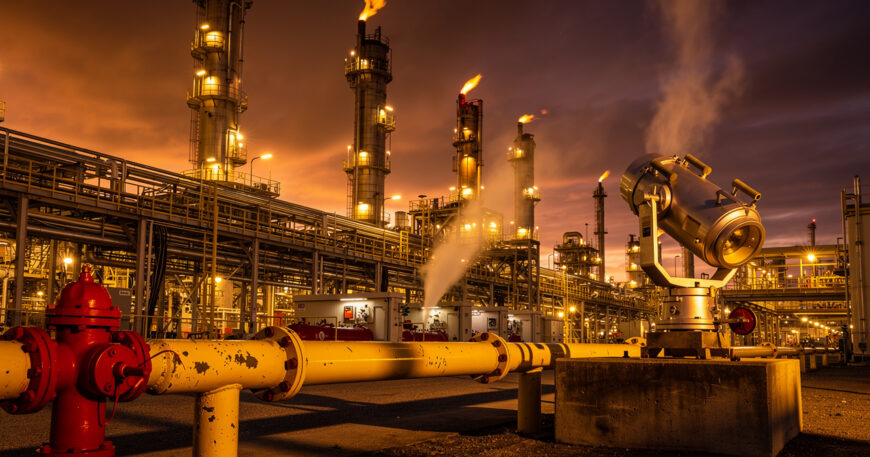
Hydrocarbon fires in petroleum refineries can turn a small leak into a site-wide disaster in minutes. That is why the OISD Fire Safety Compliance Guide for Indian Refineries is more than a paperwork exercise. It is a structured way to keep people, assets, and neighbors safe.
Refinery regulations often feel dense and technical, and OISD Standard 116 usually sits at the center of that complexity. Miss one clause on fire water design or foam storage and the whole protection strategy starts to weaken. At the same time, regulators expect every system to match current OISD, PNGRB, and PESO expectations.
In this guide, we explain what OISD Standard 116 covers, how it applies to petroleum refineries, and what core fire protection infrastructure it expects. We also walk through inspection and testing duties, emergency preparedness, and how our team at Seaara Universal Private Limited supports plants that want full, auditable compliance. If refinery fire safety is your responsibility, the next sections give you a practical roadmap.
Tip: Treat every small incident or leak report as a learning opportunity for your fire safety program, not just as a maintenance task.
Key Takeaways
This section summarizes the main lessons from the OISD Fire Safety Compliance Guide for Indian Petroleum Refineries. You can treat it like a quick checklist while reading the detailed sections that follow. Each point links directly to requirements in OISD Standard 116 and related Indian regulations.
- OISD Standard 116 sets mandatory fire protection rules for petroleum refineries, gas processing plants, LPG facilities, and petrochemical units inside refinery limits. The standard expects each site to be self-sufficient in firefighting and not rely on city fire brigades. It connects directly with PNGRB authorization, PESO licensing, and the Petroleum Rules, so non-compliance can halt operations.
- The design philosophy centers on handling two large fires at the same time in any part of the installation. To support that, OISD 116 defines fire water demand, ring main sizing, minimum residual pressure, and storage volume in clear numbers. These figures become the baseline for every pump, monitor, foam system, and hydrant you install.
- Beyond installation, the standard demands structured inspection, testing, and training so systems actually work when needed. Regular pump runs, foam testing, gas detector calibration, and full-scale mock drills all sit inside OISD guidance. As OISD stresses, documented readiness is as important as equipment on paper.
- Seaara Universal Private Limited helps refinery operators connect these technical rules with real projects, from hydrant networks to clean agent systems and fire audits. We combine aerosol and micro mist suppression, NOTIFIER USA detection systems, certified firefighting manpower, and AMCs into one coordinated program. That way, plants can line up with OISD, ISI, CE, UL, and PNGRB expectations through a single accountable partner.
What Is OISD Standard 116 and Why Does It Apply to Your Refinery?

OISD Standard 116 is the Indian rulebook that defines how petroleum refineries and related plants must design and operate fire protection systems. The standard applies to refineries, gas processing plants, LPG facilities, and petrochemical units within refinery boundaries, so almost every part of a modern complex falls under its scope.
The Oil Industry Safety Directorate, under the Ministry of Petroleum and Natural Gas, issued OISD 116 to set uniform safety rules across the hydrocarbon chain. It first came out in 1991 and now has a major 2025 revision that aligns more closely with NFPA and National Building Code practices, according to OISD. The updated document widens its reach to petrochemical complexes that earlier sat in a grey zone.
For refinery operators, the key point is scope. OISD 116 covers:
- Storage tank farms
- Process units
- LPG spheres and bullets
- Loading gantries and truck or wagon filling areas
- Pipe racks and manifolds
- Selected utilities located inside refinery limits
It assumes city fire brigades will not be available during a major incident, so the site must have its own water, foam, detection, and emergency manpower ready at all times.
The legal hook is strong. The Petroleum and Natural Gas Regulatory Board, or PNGRB, uses OISD standards as a reference when granting and renewing authorizations. Non-compliance can attract penalties up to ₹25 lakh and even suspension of operations under the PNGRB Act 2006. OISD 116 also links with PESO approvals under the Petroleum Act 1934 and Petroleum Rules 2002, so ignoring it threatens both safety and business continuity.
Because of that, we treat this standard as the backbone of any OISD Fire Safety Compliance Guide for Indian Petroleum Refineries, not as an optional guideline. Once the scope is clear, the next step is to understand the infrastructure it expects.
Core Fire Protection Infrastructure Requirements Under OISD 116

Core fire protection requirements under OISD 116 focus on a simple idea: the refinery must be able to fight two major fires at once. Every hydrant, pump, tank, monitor, and foam line works toward that design scenario, and research on the Optimal Design of Water distribution networks confirms that demand uncertainty must be factored into every sizing calculation. When we design or audit systems, we start from these assumptions and then work into the details.
At a high level, the standard expects:
- A dependable fire water system with adequate storage and pressure
- Correctly sized foam and water spray systems for tanks and LPG equipment
- Dedicated clean agent protection for critical control and electrical rooms
The fire water system is the backbone. OISD 116 asks the ring main to supply 120 percent of the calculated design flow while keeping at least 7.0 kg per square centimeter gauge at the hydraulically remotest hydrant. Jockey pumps keep that pressure ready before any emergency demand starts. Storage tanks or reservoirs must hold at least four hours of water at the aggregate pump capacity, split into two interconnected compartments for flexibility.
Pump philosophy is also firm, and a Literature Review on Fault diagnosis methods for main pump systems highlights why redundancy and regular condition monitoring are non-negotiable in high-consequence environments like petroleum refineries. Electric motor driven and diesel engine driven centrifugal pumps must both be present, and at least half of the total pumps, including standby, must run on diesel. Those diesel-driven pumps must alone be able to deliver at least half of the total fire water demand so a power failure does not remove firefighting capability. According to NFPA, fixed water based systems such as hydrants and sprinklers can cut fire death rates by around 80 percent when they work correctly, which shows why pump reliability matters.
Tank farms and LPG areas add special design loads. OISD 116 fixes water spray application rates for tank shells and nearby tanks, usually 3 liters per minute per square meter for atmospheric petroleum tanks and 10.2 liters for LPG or other pressure vessels. Floating roof tanks need rim seal protection plus a separate calculation for the worst case roof sinking incident, with An inherent safety assessment tool for storage tank farm layout confirming that fire domino effects must be modeled dynamically to capture true risk exposure. These numbers flow directly into pump sizing and ring main diameter.
Foam systems are the second pillar. The standard expects at least 90 percent of stored foam compound to be Aqueous Film Forming Foam, or AFFF, and sets a base stock of 60,000 liters for many sites. Foam application rates for fixed roof tanks start around 5 liters per minute per square meter of liquid surface with a discharge time of at least 65 minutes. High Volume Long Range monitors must be UL, FM, or BIS certified, at least two per large tank, and sized to deliver around 9.75 liters per minute per square meter to reach the tank center.
Clean agent systems round out protection for control rooms, satellite rack rooms, and instrument rooms. OISD 116 points to NFPA 2001, and systems must use agents listed or approved by UL, FM, VdS, LPCB, or BIS. In our work at Seaara Universal Private Limited, we often pair these clean agent systems with advanced detection from NOTIFIER USA so rooms that run the plant can keep operating even when a process area fire is burning outside.
What Are the Inspection, Testing, and Maintenance Obligations Under OISD 116?

Inspection, testing, and maintenance duties under OISD 116 turn a static design into a living fire safety program. The standard expects refinery teams to prove, not just claim, that systems remain ready day after day. That means test sheets, logs, and mock drill records must always be up to date and easy to retrieve.
Tip: Keep a single fire safety register or digital dashboard where every test, defect, and corrective action is recorded against the relevant OISD clause.
Fire water pumps have strict routines:
- Run each main pump at least twice per week
- Carry out a full performance test every six months, as stated by OISD
- Check jockey pumps frequently so line pressure stays within the set band
- Inspect hydrants, monitors, and ring mains visually every month
- Perform at least one annual flow and leak test on the network
Foam and water spray systems bring their own calendar. Fixed foam systems on storage tanks need annual testing, including foam maker and foam chamber checks, to show correct proportioning. Water spray systems on tanks and process equipment require inspection roughly every six months. LPG deluge systems should run on water at least once every three months so valves, nozzles, and detectors show healthy responses.
Detection and clean agent systems sit under similar expectations. Hydrocarbon and toxic gas detectors must undergo quarterly operability checks and calibration with test gas every six months, as supported by research on A Novel Intelligent Condition monitoring framework for essential service water pumps that demonstrates how structured testing protocols prevent undetected equipment degradation. Clean agent containers need quantity and pressure checks twice per year, with a full system inspection annually as OISD recommends. According to the National Disaster Management Authority, regular drills and equipment tests are among the most effective ways to reduce industrial accident impacts.
Organizational readiness is the human side of this picture, and research on Developing an integrated model for improving occupational health and safety performance confirms that structured safety management systems significantly reduce incident rates in high-hazard industries. OISD 116 expects a structured fire and safety department starting at DGM or Chief Manager level, with trained fire officers and operators on rotating shifts. Monthly mock drills must cover tank fires, LPG leaks, gantry incidents, and pipeline fires, including mutual aid participation. Emergency levels from I to III tie into PNGRB siren codes so everyone on site understands the seriousness of each signal.
When we help clients build logs and AMC plans, we design them to mirror these OISD tables. That way, during an audit or PNGRB visit, records speak clearly that the refinery follows the OISD Fire Safety Compliance Guide for Indian Petroleum Refineries not only in hardware but also in day-to-day practice.
How Seaara Universal Private Limited Supports OISD Fire Safety Compliance

Supporting OISD fire safety compliance for Indian petroleum refineries is at the core of what we do at Seaara Universal Private Limited. We work as a single partner that links design, products, detection, manpower, and maintenance into one coherent program. Our goal is simple: to make it easier for refinery teams to match the intent and letter of OISD 116.
On the infrastructure side, we design and commission hydrant, monitor, and water spray systems that follow OISD 116 and related OISD 117 and 118 guidance. Our engineers size fire water storage, pumps, and ring mains to meet the two simultaneous fire scenario, using hydraulic calculations that reflect real layouts instead of only theoretical tables. When tank farms or LPG spheres are involved, we align water spray densities, foam stock, and HVLR monitor coverage with both OISD figures and global references such as NFPA and API.
We also supply and integrate fire suppression technologies that match refinery realities. As the pioneer of Aerosol Suppression Systems using fourth generation technology in India, we apply aerosol units in enclosed high risk rooms like control centers, substations, and cable galleries where water is not ideal. Our Micro Mist Technology Systems protect process areas that need fast knockdown with minimal water damage. For open hazards, we provide deluge and sprinkler systems that align with NFPA 15, NFPA 13, and the latest OISD 116 tables.
Detection and alarm form another pillar of our support. As an authorized partner of NOTIFIER USA, we deploy addressable fire alarm and gas detection systems that handle harsh refinery environments. We tie signals from hydrocarbon and toxic gas detectors to water spray, water curtain, and clean agent systems so automatic actions match OISD expectations. According to OSHA, early detection and rapid alarm greatly reduce the scale of industrial fires, which fits the logic behind these integrated designs.
Beyond projects, we stay with plants through Annual Maintenance Contracts (AMCs) and fire safety audits. Our ISO 9001 certified processes cover periodic testing, calibration, and repair of hydrant networks, foam systems, clean agent cylinders, and fire trucks, all documented for OISD and PNGRB inspections. During audits, we run structured gap assessments against the OISD Fire Safety Compliance Guide for Indian Petroleum Refineries and prepare practical upgrade plans that match budgets and shutdown windows. That way, management teams can show regulators and insurers that they treat refinery fire safety as an ongoing discipline, not a one-time project.
Building a Compliant and Resilient Refinery Fire Safety Program

Building a compliant and resilient refinery fire safety program means using OISD 116 as a daily reference, not just a shelf document. The standard ties together infrastructure, foam, clean agents, detection, manpower, and testing into one system that must stand on its own during an emergency. When all those parts work together, the site protects people, assets, and the surrounding community.
We see the OISD Fire Safety Compliance Guide for Indian Petroleum Refineries as the bridge between this standard and real facilities. By following its structure, safety managers can confirm that fire water design, tank farm protection, gas detection, and emergency drills line up with both Indian rules and global practice. The 2025 revision raises the bar, but it also gives clearer direction.
Seaara Universal Private Limited exists to make that path practical. With ISO 9001 systems, advanced aerosol and micro mist suppression, NOTIFIER USA detection, and strong AMC and manpower support, we bring all the moving parts under one roof. If you want a fresh fire audit or a focused gap assessment against OISD 116, we are ready to work with your team and build a safer refinery together.
“An ounce of prevention is worth a pound of cure.” — Benjamin Franklin
Frequently Asked Questions
Question 1: What Is the Difference Between OISD 116 and OISD 117?
- OISD 116 covers fire protection for petroleum refineries, gas processing plants, LPG facilities, and petrochemical units within refinery limits.
- OISD 117 applies to petroleum product marketing locations such as depots, terminals, and standalone storage outside refinery premises.
In short, process refineries follow OISD 116, while independent marketing and distribution sites use OISD 117 as their main fire standard.
Question 2: How Often Must a Petroleum Refinery Conduct a Fire Safety Audit Under OISD?
A petroleum refinery must conduct an internal fire protection system audit at least once every three years. The audit checks compliance with all applicable OISD standards, including OISD 116, 117, and 118. Findings and action plans should remain documented and available for review by PNGRB, OISD inspectors, and other statutory authorities during safety and authorization inspections.
Question 3: Are Clean Agent Fire Suppression Systems Mandatory in Petroleum Refineries?
Yes, clean agent fire suppression systems are mandatory for specific areas in petroleum refineries. OISD 116 calls for total flooding clean agent protection for control rooms, satellite rack rooms, instrument panel rooms, and similar spaces. Systems must follow NFPA 2001 and use agents and hardware listed or approved by UL, FM, VdS, LPCB, or BIS, with a full standby charge per hazard.
Question 4: What Percentage of Fire Water Pumps Must Be Diesel Driven Under OISD 116?
At least 50 percent of the total fire water pumps, including standby units, must be diesel driven under OISD 116. Those diesel pumps must by themselves deliver at least half of the total required fire water flow. This setup keeps firefighting capacity available even during complete electrical power failure or major switchboard faults at the refinery.
Question 5: Can a Third-Party Fire Safety Company Supply Both Equipment and Manpower for OISD Compliance?
Yes, a specialized fire safety company can supply both equipment and manpower that support the OISD Fire Safety Compliance Guide for Indian Petroleum Refineries. Seaara Universal Private Limited, for example, provides hydrant systems, suppression systems, detection networks, firefighting vehicles, and certified firefighting staff. Working with a single vendor reduces coordination effort and helps keep documentation, testing, and upgrades aligned with OISD requirements.