

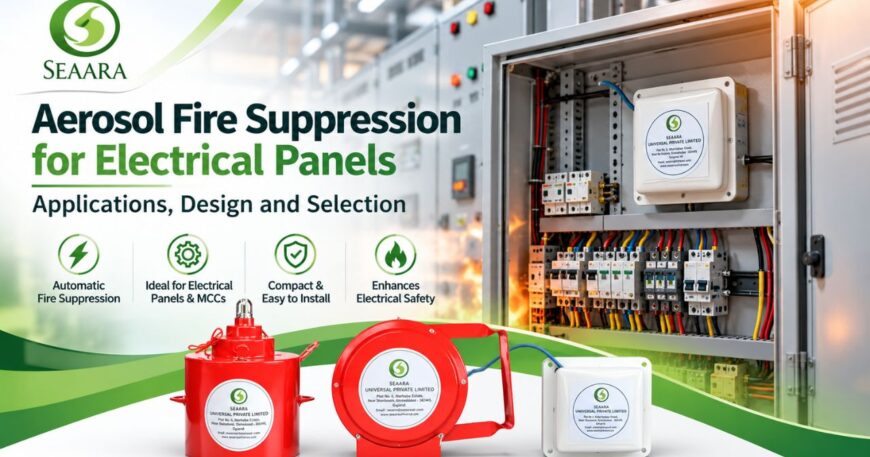
Could a loose termination, arc fault, or overheating contactor halt a critical process before anyone notices? Can a room-level fire protection system provide the same localized protection as a suppression system designed specifically for a closed MCC panel or PLC cabinet? The right choice for aerosol fire suppression for electrical panels is not a single generator model. It is a correctly engineered condensed aerosol system matched to the enclosure, fire load, ventilation, and shutdown logic.
Aerosol fire suppression for electrical panels provides localised, automatic suppression inside enclosed electrical equipment. It supplements electrical maintenance, overcurrent protection, detection, isolation, and emergency response rather than replacing them. Seaara Universal Private Limited provides aerosol systems for electrical cabinets and control rooms, with project support from design through commissioning. The sections below explain applications, activation, selection, installation, limitations, and lifecycle controls.
Key Takeaways
Aerosol suppression system for electrical panels can limit flame spread within enclosed electrical equipment when the system matches the actual hazard.
Localised enclosure protection is suited to compact, reasonably enclosed cabinets with defined ignition risks. MCC panels, switchgear, PLC cabinets, UPS-related panels, and automation enclosures are common candidates. Open or heavily ventilated equipment needs separate engineering review.
Generator selection depends on survey data rather than cabinet appearance alone. Internal free volume, obstructions, ventilation openings, heat sources, and compartment divisions affect the design. Electrical isolation logic also requires review before release sequencing is approved.
Layered protection remains necessary after aerosol installation. Preventive maintenance, thermography, correct torque, fire detection, alarms, and trained response personnel reduce the likelihood and consequence of panel fires. A discharged generator requires replacement and recommissioning.
Table of Contents
- What Makes Electrical Panels Vulnerable to Fire?
- How Does Condensed Aerosol Fire Suppression Work in Electrical Cabinets?
- How Should You Design and Select an Aerosol Suppression System for Electrical Panels?
- When Is Aerosol Suppression Not Enough for Electrical and Battery Hazards?
- How Do Installation, Commissioning, and Maintenance Protect System Reliability?
- The Bottom Line
- Frequently Asked Questions
- Can Aerosol Fire Suppression Be Installed Inside an Electrical Panel?
- Does Aerosol Fire Suppression Damage Electrical Equipment?
- Can Aerosol Fire Suppression Stop an Arc Fault?
- How Often Should an Aerosol Fire Suppression System Be Inspected?
- Can Aerosol Suppression Be Used for MCC Panels and Switchgear?
- What Happens After an Aerosol Generator Discharges?
What Makes Electrical Panels Vulnerable to Fire?
Electrical panels are vulnerable because they concentrate energised conductors, combustible insulation, heat-producing components, and potential fault points inside confined enclosures. Room-level protection may not provide the same localized detection and suppression approach as a system designed specifically for the electrical enclosure.. A local fire safety audit should review electrical rooms, MCC line-ups, LT and HT panels, distribution boards, switchgear, PLC enclosures, UPS cabinets, and automation systems. Facilities with continuous processes, limited access, high replacement costs, or public-service obligations often face higher consequences after a panel fire.
Common Ignition Sources in MCCs, Switchgear, and Control Panels
MCCs, switchgear, and control panels can experience loose terminations, overloaded conductors, insulation degradation, short circuits, arc faults, failed relays, and overheated contactors. Power-supply failures can ignite cable jackets, polymer housings, dust deposits, or oil mist around tightly packed components. Aerosol fire suppression for electrical panels is useful where energised equipment and restricted cabinet access delay manual intervention. Unattended PLC panels, UPS cabinets, distribution boards, and automation panels deserve particular attention during hazard surveys.
Electrical faults may continue after visible flames begin, especially where backfeeds, control transformers, battery supplies, or emergency circuits remain live. Applicable electrical regulations, equipment instructions, and facility lockout procedures should guide isolation planning. fire safety should treat electrical maintenance as the first protective layer because suppression cannot correct poor torque practices, damaged insulation, or unsuitable loading. Infrared inspections and routine cleaning also reduce contamination-related ignition risk.
Where Is Aerosol Fire Suppression for Electrical Panels Most Suitable?
Aerosol fire suppression for electrical panels is most suitable for compact electrical cabinets with reasonably enclosed volumes and clearly defined fire hazards. Electrical control rooms, MCC panels, switchgear cabinets, PLC enclosures, communications cabinets, and automation panels can benefit where downtime would disrupt operations, a use case documented in condensed aerosol fire protection system designs built specifically for electrical cabinet enclosures. Industrial plants, refineries, chemical facilities, municipal infrastructure, data areas, and commercial building controls often contain such risks. The protected enclosure must retain the agent long enough for effective flame suppression.
An electrical panel suppression products should not be selected by default for open-frame equipment, large electrical rooms, or cabinets with unrestricted airflow. Large louvers, operating fans, damaged door seals, and extensive cable penetrations may reduce agent retention. Applicable authority requirements, manufacturer instructions, and project specifications should shape the final arrangement. A qualified review can determine whether aerosol, water mist technology, a clean-agent system, or another method suits the hazard.
How Does Condensed Aerosol Fire Suppression Work in Electrical Cabinets?
aerosol fire suppression system releases fine active particles inside an enclosed electrical cabinet after thermal or electrical activation. Aerosol fire suppression for electrical panels interrupts the combustion chain reaction rather than relying mainly on water discharge or substantial oxygen reduction. The generator contains a solid extinguishing compound and does not require a pressurised cylinder or extensive piping network. System performance depends on the defined enclosure volume, agent distribution, activation timing, ventilation response, and electrical shutdown arrangement.
How an Aerosol Generator Suppresses a Developing Panel Fire
An aerosol generator for electrical panels stores a solid compound that produces fine particles and gaseous components after activation. These particles react with unstable combustion free radicals and interrupt flame propagation within the protected enclosure. This supports compact installation and avoids the water damage associated with fire sprinklers. Properly selected systems can protect sensitive electrical and electronic environments without extensive discharge piping.
Condensed Aerosol fire suppression for electrical panels does not make a cabinet damage-free after an incident. Heat, soot, arc damage, and aerosol deposits may still require electrical inspection and cleaning before re-energisation. The activated generator is generally a single-use component that needs replacement after discharge. Equipment manufacturers and aerosol generators should confirm material compatibility, clearances, and post-event procedures.
Which Activation Method Fits the Electrical Panel Risk?
Thermal activation places a heat-sensitive element near likely ignition points, such as busbars, terminals, contactors, or cable concentrations. The device must remain away from normal heat sources that could cause unwanted operation during ordinary service. This approach can suit smaller control-panel fire suppression applications with limited wiring infrastructure. Cabinet temperature, seasonal conditions, solar exposure, and fan-failure scenarios should be reviewed during placement.
Electrical activation can be integrated with the system’s detection and release arrangement according to the project design. Depending on the system configuration, activation may also be thermal or manual. It can provide alarm transmission, remote status, fan shutdown, electrical isolation, and integration with the site fire alarm system. Manual release offers an additional response option, but it cannot replace automatic protection for unattended or mission-sensitive cabinets. Refineries and chemical plants should review shutdown sequences with operations, electrical, instrumentation, and process-safety personnel before installation.
How Should You Design and Select an Aerosol Fire Suppression System for Electrical Panels?
Designing aerosol fire suppression for electrical panels begins with a documented hazard survey, not a generator size assumption. The selected system must match the protected volume, internal arrangement, ventilation pattern, ambient environment, and manufacturer-supported design criteria. Generator placement must also preserve access to breakers, grounding points, arc-flash barriers, cooling routes, and inspection windows. Divided, tall, or obstructed cabinets may need multiple units for distribution across separate compartments.
Electrical Panel Survey and Design Checklist
An electrical panel survey should measure internal free volume instead of relying only on external cabinet dimensions. Engineers should record partitions, busbars, cable bundles, drives, transformers, batteries, and likely ignition points. Fans, louvers, cable penetrations, door seals, pressure-relief paths, and normal airflow conditions also affect aerosol retention. The survey should identify all power sources, including backfeeds, control transformers, battery supplies, and emergency circuits.
Environmental conditions influence both generator placement and activation selection. Review normal internal temperature, humidity, dust, oil mist, vibration, corrosive exposure, outdoor weather, and personnel access. Mounting locations must provide suitable discharge paths and required clearances from energised components. The installation must also preserve the electrical enclosure’s original safety functions and environmental rating.
SAG Aerosol Generator Selection Framework for Electrical Panels
SAG aerosol generator selection for aerosol fire suppression for electrical panels should follow the current catalogue, protected volume, compartment arrangement, ventilation, fire load, and project requirements. Seaara Universal Private Limited lists SAG models for application review, but no model should receive a coverage or approval claim without current manufacturer documentation. Multiple generators may be required where cabinets have vertical divisions, internal barriers, or separated equipment bays. The following table supports a structured discussion with a qualified fire protection specialist.
| SAG Model | Catalogue-Listed Model Reference | Potential Electrical Panel Application | Selection Inputs to Verify | Final Design Requirement |
|---|---|---|---|---|
| SAG 3-0.03 | 3-0.03 | Compact enclosed cabinet | Volume and obstruction review | Confirm with current documentation |
| SAG 3-0.05 | 3-0.05 | Small control enclosure | Heat sources and ventilation | Confirm project-specific design |
| SAG 3-0.3 | 3-0.3 | Electrical cabinet | Layout and cable density | Confirm placement and release method |
| SAG 3-0.5 | 3-0.5 | Control panel | Free volume and partitions | Confirm manufacturer criteria |
| SAG 3-1 | 3-1 | MCC compartment | Compartment separation | Confirm final system arrangement |
| SAG 3-2 | 3-2 | Switchgear section | Ventilation and fault risk | Confirm design documentation |
| SAG 3-3 | 3-3 | Larger enclosed panel | Internal obstructions | Confirm generator quantity |
| SAG 3-4 | 3-4 | Larger enclosed electrical equipment | Room integrity and occupancy | Confirm hazard-specific approach |
| SAG 3-7 | 3-7 | Larger protected enclosure | Distribution and shutdown logic | Confirm project requirements |
| Transformer Model | 3-4-1 | Transformer-related application | Equipment configuration | Confirm catalogue suitability |
Discuss an electrical-panel aerosol design with Seaara Universal Private Limited.
When Is Aerosol Suppression Not Enough for Electrical and Battery Hazards?
Aerosol suppression is not enough when the hazard involves major ventilation losses, deep-seated combustion, large open spaces, or lithium-ion thermal runaway. Aerosol fire suppression for electrical panels works best as part of layered protection that includes prevention, detection, electrical isolation, maintenance, and emergency response. It may suppress flames involving wiring and combustible panel contents while leaving heated conductors or battery cells capable of reignition. Project teams should define the realistic fire scenario before selecting the suppression method.
Lithium-Ion Battery Thermal Runaway Requires a Separate Strategy
Lithium-ion battery thermal runaway involves a self-heating internal cell reaction that may continue after visible flames disappear. Research on aerosol extinguishing agents for battery vent gases and hydrogen shows aerosol may suppress flames involving wiring, chargers, contactors, inverters, plastics, and adjacent combustibles, but effectiveness against vented battery gases varies by agent composition. It may not stop internal cell heating or prevent reignition after a battery event. Battery protection requires a design based on the chemistry, enclosure, charging arrangement, and emergency plan.
A battery strategy should combine battery management systems, independent addressable heat detector, charging shutdown, electrical isolation, gas management, and fire-resistant enclosure design. Cooling and post-event monitoring may be necessary when cells remain hot after suppression. Lithium iron phosphate batteries may behave differently from other lithium-ion chemistries, but no chemistry is free from fire risk. Emergency responders need clear access, isolation information, and a defined escalation plan.
Ventilation, Leakage, Residue, and Concealed-Fire Risks
Ventilation, leakage, residue, and concealed fires can reduce the effectiveness of aerosol suppression inside electrical equipment. Large openings, active fans, louvers, damaged seals, and cable penetrations can release the agent before it acts. Deep-seated fires behind dense components or within closed equipment may receive uneven agent distribution and insufficient cooling. Fan shutdown, dampers, sealing changes, and pressure management require engineering review.
Aerosol should not be described as residue-free or universally harmless to every electronic assembly. Equipment compatibility, cleanup methods, worker exposure, and re-entry procedures should be reviewed before specification. After a discharge, personnel should isolate power and inspect for hot surfaces, hidden arc damage, and possible reignition. The cabinet should not return to service until qualified electrical and fire protection personnel approve it.
How Do Installation, Commissioning, and Maintenance Protect System Reliability?
Installation, commissioning, and maintenance protect system reliability by confirming that the aerosol system releases correctly and does not compromise electrical safety. Qualified personnel should coordinate aerosol fire suppression for electrical panels work with facility operations, electrical authorities, and lockout procedures. Qualified personnel should coordinate work with facility operations, electrical authorities, and lockout procedures. Seaara Universal Private Limited supports design, supply, erection, testing, and commissioning within a wider fire protection project.
Installation and Commissioning Controls for Electrical Cabinets
Installation controls should provide secure generator mounting, unobstructed discharge paths, correct detector placement, and protected release wiring. Where applicable, a cause-and-effect matrix should document addressable sounder beacon, release logic, fan control, electrical isolation, shutdown functions, and remote notification. Functional testing should verify detection, supervisory signals, manual release, and interlocks without unintended discharge. Labels should identify the protected cabinet, suppression type, isolation actions, and post-discharge restrictions.
Commissioning also requires coordination with operations and emergency-response personnel. Lockout and tagout procedures should address normal supplies, backfeeds, battery circuits, and emergency power sources. Operators need instruction on alarms, evacuation, isolation, safe access, and notification procedures. Testing records should remain available for facility audits, maintenance planning, and authority review.
Inspection, Post-Discharge Response, and System Replacement
Routine inspections should check generator condition, mounting, activation components, wiring, status indicators, ventilation changes, and cabinet modifications. After discharge, isolate power, restrict access, ventilate safely, investigate the cause, inspect for arc damage or reignition, clean as required, replace the activated generator, and recommission the system. Recordkeeping and spare-unit planning reduce the time a vital panel remains without protection.
The Bottom Line
Aerosol fire suppression for electrical panels provides rapid, compact, enclosure-level protection when the selected system matches the actual cabinet hazard. The decision should account for volume, ventilation, equipment layout, activation method, electrical isolation, equipment compatibility, maintenance needs, and battery limitations. It serves as a supplementary layer beside preventive maintenance, correct circuit protection, alarms, and trained emergency response.
Seaara Universal Private Limited can review electrical cabinets, MCCs, switchgear, and control-panel applications as part of a project-specific fire protection plan. A documented survey and engineered release sequence provide a stronger basis for selection than a generic product comparison. Routine thermographic inspection can help identify abnormal heating at connections and components before a fault develops into a fire. The objective is to protect the process, the equipment, and the people responsible for operating it.
Frequently Asked Questions
Electrical-panel aerosol systems require application-specific review because cabinet conditions and operational consequences vary widely. The following answers address common specification and maintenance questions. Product instructions, local requirements, and qualified engineering judgement should guide the final installation.
Can Aerosol Fire Suppression Be Installed Inside an Electrical Panel?
Yes, compact aerosol generators can be installed inside enclosed electrical panels when selected for the cabinet and installed to product instructions. The review should cover internal volume, heat sources, obstructions, ventilation, clearances, and electrical safety requirements.
Does Aerosol Fire Suppression Damage Electrical Equipment?
Aerosol avoids water discharge, but it is not automatically damage-free. Equipment compatibility, possible deposits, cleaning procedures, and post-fire electrical inspection should be reviewed before the panel is returned to service.
Can Aerosol Fire Suppression Stop an Arc Fault?
Aerosol can suppress flames caused by an arc fault, but it does not stop the electrical fault itself. Arc-fault prevention, overcurrent protection, maintenance, and safe electrical isolation remain necessary.
How Often Should an Aerosol Fire Suppression System Be Inspected?
Inspection intervals should follow product instructions, site policy, project requirements, and authority requirements. Reviews should check physical condition, mounting, activation components, wiring, status indicators, and cabinet changes.
Can Aerosol Suppression Be Used for MCC Panels and Switchgear?
Yes, MCC panels and switchgear can be assessed as potential applications for aerosol suppression. Generator selection depends on enclosure layout, partitions, fault risk, ventilation, equipment access, and required shutdown logic.
What Happens After an Aerosol Generator Discharges?
After discharge, isolate power, restrict access, ventilate safely, investigate the fire cause, and inspect for heat damage or reignition. Replace the activated generator and recommission the system before returning the electrical panel to service.