
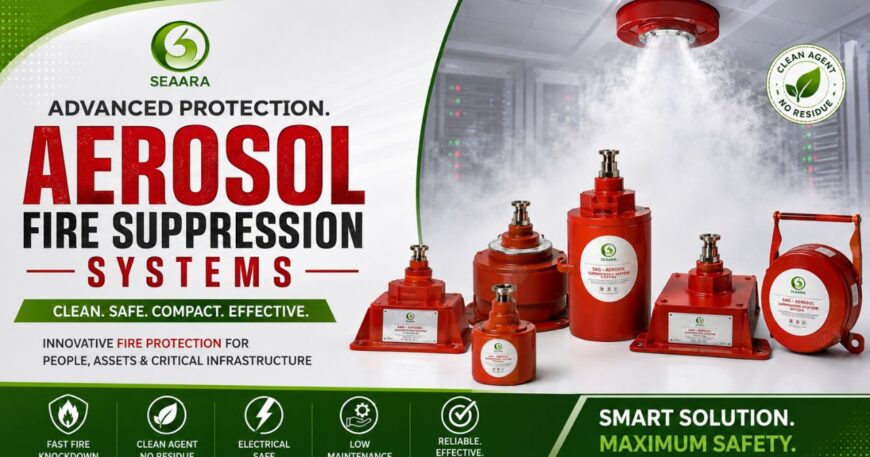
An aerosol fire suppression system is a fixed or modular fire protection system that uses condensed aerosol particles instead of water, gas, or foam to extinguish fire. The system works by releasing ultra-fine solid particles from compact generators, which spread through the enclosure and interrupt the chemical reactions that keep flames burning. Unlike sprinklers or gas flooding, the technique focuses on combustion chemistry rather than large volumes of water or high-pressure gas.
For Indian industrial and electrical environments, compact automatic aerosol fire suppression matters because many hazards sit inside sealed panels, control cabinets, generator rooms, and small technical spaces. These areas often cannot accommodate cylinder banks or extensive piping, yet they contain high-value equipment and critical power or control functions. Seaara Universal Private Limited provides condensed aerosol technology for exactly these types of enclosures, linking small generators with reliable detection and control.
This article explains what an aerosol suppression system is, how condensed aerosol technology works, where it fits in industrial and commercial facilities, and how to design, install, and maintain such systems in India. It also outlines strengths and limitations compared with gas and water-based methods, and describes how a specialist partner supports engineering, commissioning, and lifecycle service. The sections that follow help technical decision makers move from concept to practical project planning.
Key Takeaways
Aerosol fire suppression systems use condensed aerosol particles to interrupt combustion instead of relying on water, foam, or high-pressure gas. The particles neutralize flame radicals and absorb heat, which stops the fire chain reaction in a matter of seconds. This approach fits compact enclosures and sensitive electrical or electronic assets where water or high-pressure cylinders are difficult to accommodate.
Condensed aerosol fire suppression suits electrical panels, MCCs, switchgear, UPS rooms, server rooms, data centers, DG rooms, transformers, control cabinets, CNC machines, and other confined industrial spaces. In many Indian facilities, aerosol protection complements sprinklers, hydrants, CO2, inert gas, and water mist so that each hazard zone receives a fitting suppression method. The result is layered protection for both building fabric and critical equipment.
Compared with many gas systems, an aerosol generator is compact, pipe-less, and relatively simple to install and maintain. These systems reduce water damage risk and typically have favorable environmental characteristics, while still leaving a fine particulate residue that needs planned cleanup. Correct design, installation, and maintenance are essential, along with compliance with NFPA 2010, the National Building Code of India, and local Fire NOC requirements, often guided by a partner with aerosol engineering expertise.
Table of Contents
- What Is An Aerosol Fire Suppression System?
- How Does A Condensed Aerosol Fire Suppression System Work?
- Key Components And Types Of Aerosol Fire Suppression Systems
- Applications Of Aerosol Fire Suppression Systems In Industrial And Commercial Facilities
- Advantages And Limitations Of Aerosol Fire Suppression Systems
- Design, Selection, And Standards For Aerosol Fire Suppression In India
- Installation, Integration, And Commissioning Best Practices
- Operation, Inspection, Maintenance, And Safety For Aerosol Systems
- Role Of Seaara Universal Private Limited In Aerosol Fire Suppression Projects
- To Sum Up
- Frequently Asked Questions
- How Safe Are Aerosol Fire Suppression Systems For Occupied Rooms?
- Can Aerosol Fire Suppression Protect Open Or Highly Ventilated Areas?
- How Does Aerosol Fire Suppression Compare To Inert Gas And Clean Agent Gas Systems?
- What Happens After An Aerosol System Discharges?
- Are Aerosol Fire Suppression Systems Approved Under Indian Codes And By Fire Authorities?
- How Do I Decide If Aerosol Is Suitable For My Specific Electrical Or Industrial Hazard?
What Is An Aerosol Fire Suppression System?
Aerosol fire suppression systems are fixed or modular systems that extinguish fires by releasing a cloud of ultra-fine solid particles and inert gases into the protected volume. Instead of pumping water, foam, or high-pressure clean agents through pipes and nozzles, an aerosol fire suppression system uses small metal generators that store a solid aerosol-forming compound and discharge directly into the room or enclosure when triggered. These systems can protect full rooms as total flooding systems or smaller micro-environments as local application systems.
Definition, Terminology, And Core Concepts
An aerosol fire suppression system is a fixed, automatic or manual fire extinguishing system that uses condensed aerosol agents created by a solid charge inside a generator. The aerosol is a suspension of sub-micron or micron-sized particles, often based on potassium salts, carried by hot gases that cool as they pass through internal filters. In industry, such units are often called condensed aerosol fire suppression systems, aerosol suppression systems, or fire suppression aerosol generators, all focusing on the same basic mechanism.
Condensed aerosol differs from dry chemical powder and gaseous clean agents in important ways:
Dry chemical relies on relatively coarse powder discharged from pressurized cylinders and often leaves thick deposits.
Clean agent gases flood a room using high-pressure piping and mainly displace heat or oxygen.
Condensed aerosol sits between these concepts, using very fine particles with gas-like behavior, generated in place without large pressure vessels.
Aerosol systems can be automatic, triggered by detectors or thermal links, or manual through release stations, and can be engineered for total flooding of rooms or targeted local application. Properly tested formulations can address Class A surface fires, Class B flammable liquids, and energized electrical hazards.
Aerosol Systems In The Indian Industrial Context
In Indian plants and commercial facilities, an aerosol suppression system typically protects:
LT and HT switchgear
Control cabinets and PLC panels
Diesel generator enclosures and DG rooms
Transformers and compact substations
CNC machines and other enclosed industrial machinery
These installations often sit inside broader fire strategies that still rely on sprinklers, hydrants, CO2, inert gas, and water mist for large halls, process units, and oil storage. For wide, tall, or heavily ventilated spaces, aerosol is usually not the primary method, and designers favor sprinkler or water spray systems to deal with structural and high fuel load risks.
How Does A Condensed Aerosol Fire Suppression System Work?
A condensed aerosol fire suppression system works by chemically interrupting combustion and absorbing heat rather than simply reducing oxygen or soaking fuels. When detection signals a fire, the system activates aerosol generators that contain a solid aerosol-forming compound, triggering a controlled pyrotechnic reaction. This reaction produces a dense aerosol cloud that fills the enclosure, where the particles neutralize critical flame radicals, cool the reaction zone, and create conditions that stop the fire and reduce re-ignition risk during a designed hold time.
Combustion Chemistry And Fire-Interruption Mechanism
Combustion in an open flame depends on a chain reaction involving highly reactive radicals, mainly hydrogen, hydroxyl, and oxygen species. In an aerosol suppression system, the generator produces potassium-rich particles that enter the flame zone and react with these radicals to form stable compounds. As the radical pool collapses, the self-sustaining combustion chain breaks, and the flame cannot continue.
Alongside radical neutralization, the large surface area of the fine particles absorbs heat from the flame and from hot gases. Some reduction in local oxygen concentration also occurs, though it is not the main extinguishing effect. Particles deposit on hot and fuel surfaces, which helps quench surface burning and reduce the chance of small flames returning. This mechanism works well for open flames and surface fires in cables, oils, and plastics, while very deep-seated Class A fires in bulky materials may need additional cooling or manual follow-up inspection.
From Detection To Discharge: System Operating Sequence
The operating sequence of an automatic aerosol suppression system typically includes:
Detection via smoke, heat, or flame detectors, or through built-in thermal elements in stand-alone generators inside panels or engine spaces.
Alarm and delay, where the control panel raises an alarm, starts pre-discharge timers, and activates sounders and flashers to warn occupants. Manual call points and abort switches give trained staff options for early release or justified delay.
Discharge, when the delay expires without abort and the panel energizes the firing circuits of the aerosol generator, initiating the pyrotechnic reaction that forms aerosol particles and gases.
Distribution, as the cloud exits through ports in the generator body and disperses throughout the protected volume, mainly by momentum and then by Brownian motion, spreading into cable voids and behind equipment.
Hold time, where the design aims to reach the required aerosol concentration quickly and then maintain it long enough to prevent re-ignition.
Fixed centralized systems control multiple generators through a common panel, while autonomous cabinet-level or machine-level modules combine detection and activation inside each enclosure without external wiring.
Key Components And Types Of Aerosol Fire Suppression Systems
Key components of an aerosol fire suppression system include aerosol generators, detection and control equipment, power supplies, human interface devices, and the enclosures being protected. The technology appears in several configurations, including fixed multi-generator systems for rooms, modular generators inside specific cabinets or machines, and combinations of automatic and manual activation strategies. Condensed aerosol is the most common format in building and industrial systems, while dispersed aerosol powders mainly appear in portable extinguishers.
Main Hardware Elements In An Aerosol Suppression System
The heart of any aerosol suppression system is the aerosol generator, usually a cylindrical or box-shaped metal housing with an internal solid compound, ignition device, cooling filters, and discharge ports. When energized, the charge burns in a controlled manner and turns into aerosol particles and carrier gases that exit through engineered openings. Generators come in various charge sizes so designers can match agent mass to the hazard volume, and they mount on walls, ceilings, or structural steel, or directly inside panels and machine compartments, as illustrated in a typical aerosol suppression tool operation manual that details deployment steps, inspection, and storage requirements for such generators.
Other main hardware elements include:
Detection and control equipment, providing the brain for automatic aerosol fire suppression. A control panel monitors detectors, manual release and abort stations, and then manages alarms, delays, and discharge outputs.
Power supplies, typically a mains supply with battery backup so that the panel and firing circuits keep working during outages, with supervised wiring to alert operators to open or short circuits.
Enclosure integrity features, including doors, dampers, and penetrations, which help maintain the design aerosol concentration by limiting leakage.
System Configurations And Application Modes
Common system configurations include:
Fixed multi-generator systems, using several generators connected to a central control panel to protect rooms or large enclosures such as control rooms, UPS rooms, DG rooms, and indoor substations.
Modular or stand-alone units, mounted directly inside electrical panels, MCCs, server racks, CNC machines, or engine compartments, using thermal cords or built-in detectors for local activation without long cable runs.
Application modes split into:
Total flooding, where the system calculates a total aerosol mass for the entire room volume and aims to reach a uniform concentration everywhere, similar to gas suppression design.
Local application, where smaller generators discharge near specific hazards, such as inside a panel or under a machine cover, focusing protection where ignition is most likely.
Both automatic and manually activated models exist, and many projects combine them, with automatic aerosol fire suppression for unmanned spaces and manual release for staffed areas. Portable aerosol extinguishers can supplement these systems but are not a replacement for fixed engineered protection.
Applications Of Aerosol Fire Suppression Systems In Industrial And Commercial Facilities
Aerosol fire suppression systems see their greatest value in protecting electrical and control assets that sit inside confined spaces across industrial and commercial facilities. In Indian plants and infrastructure projects, they appear in electrical panels, MCC rooms, substations, UPS and battery rooms, server rooms, DG rooms, small control rooms, transformer enclosures, and machine compartments. Compact generators fit well where there is little room for cylinders or piping, and they often integrate with existing fire alarm panels and process shutdown logic.
Priority Electrical And Electronic Applications
Priority applications for aerosol suppression in electrical infrastructure include:
LV and MV switchgear, MCCs, and control cabinets
UPS rooms, PLC cabinets, relay and protection panels
Server rooms, small data centers, and telecom rooms
DG rooms and generator enclosures
Indoor transformers and compact substations
Generators can be mounted inside these panels or in close proximity, linked to thermal detection or external smoke and heat detectors, so that a localized fire is suppressed before it propagates into adjoining equipment. For UPS rooms, PLC cabinets, and relay panels, designers often favor condensed aerosol fire suppression over water discharge, because even a small water leak can cause lengthy downtime.
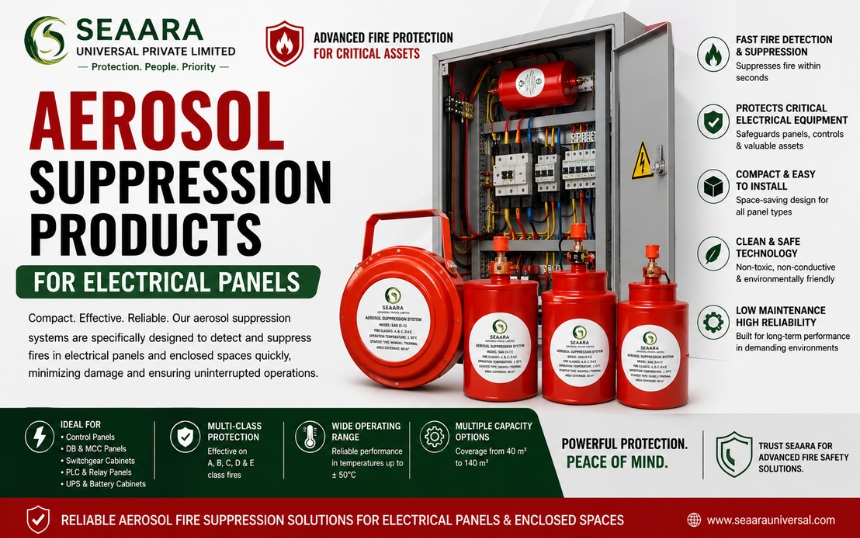
Server rooms, data centers, and telecom rooms benefit from the compact format of aerosol units, especially in edge facilities and smaller IT spaces that may not justify large clean agent cylinder banks. The design must balance cleanliness and uptime with the acceptance of fine solid residue, which many operators consider acceptable when weighed against water damage risk. Generator and DG rooms present another strong use case, as hot engine surfaces, fuel lines, and cable terminations combine to create flammable liquid and electrical fire risks in relatively tight acoustic enclosures. Indoor transformers and small substations also suit aerosol protection, because the technology can address high-energy electrical faults in confined bays without installing complex pipe runs. Seaara supplies SAG condensed aerosol generators that can be mounted in or near these types of enclosures, with electrical or thermal activation designed for rapid response.
Broader Industrial And Infrastructure Use Cases
Beyond core electrical applications, aerosol fire suppression supports many other industrial and infrastructure hazards across India, such as:
CNC machines, EDM machines, and other industrial machinery with oil-based coolants
Cable tunnels, raised floors, and small control rooms in refineries, power plants, steel mills, and cement plants
Telecom shelters, small edge data centers, renewable energy inverter rooms, and battery containers
BMS control rooms, security control centers, and key electrical riser rooms in airports, metro stations, and high-rise buildings
In many projects, aerosol systems protect compact, enclosed, and high-value assets, while sprinklers, hydrants, and water spray handle public and open areas. In selection, consultants compare aerosol with water mist, inert gas, or foam for each zone, choosing aerosol where enclosures are compact, equipment is sensitive to water, and achieving a stable design concentration is realistic.
Advantages And Limitations Of Aerosol Fire Suppression Systems
Aerosol fire suppression systems offer a distinct mix of compact hardware, rapid fire knock-down, low water damage, and favorable environmental characteristics, balanced by technical and practical limitations. They perform especially well in small to medium enclosed volumes with high-value electrical and electronic assets, while large open spaces, heavily ventilated zones, and very high cleanliness requirements may be better served by other technologies.
Operational, Economic, And Environmental Advantages
Key advantages of aerosol suppression include:
No long piping networks or cylinder banks, which simplifies both new installations and retrofits in congested plants.
Compact, lightweight generators, which can be mounted directly inside panels, under ceilings, or on structural steel without major civil work.
Fast response, as generators reach full discharge within seconds, and particles spread rapidly through the protected enclosure.
Asset-friendly behavior, as the agents, when correctly selected and applied, are safe for most electrical and electronic assets and are typically tested for compatibility with common metals and insulation.
Lower maintenance demands compared with many gas systems, because there are no high-pressure cylinders to hydro-test and fewer mechanical components, while generator design life commonly spans 10 to 15 years under recommended conditions.
Environmental benefits, since condensed aerosol agents have zero ozone depletion potential and very low global warming impact, and are often adopted as halon alternatives.
Seaara’s pressure-less SAG generators align with these advantages by using compact housings that fit local enclosures and integrate with existing alarm and control architecture.
Technical Constraints, Risks, And When Aerosol May Not Be Ideal
Despite these benefits, aerosol fire suppression has constraints that need attention during design and procurement:
The method depends on reaching and holding a design concentration of aerosol particles in the protected volume, so rooms or cabinets must be reasonably sealed.
Large openings, continuous ventilation, or open racks can dilute the aerosol and produce uneven coverage, which reduces effectiveness and may require alternative approaches such as sprinklers, water mist, or inert gas for those zones.
Fine solid residue remains after a discharge. While modern agents are formulated to be non-corrosive under normal conditions, particles will settle on surfaces and inside equipment.
For ultra-clean environments such as some Tier IV data centers or optical cleanrooms, that residue may be unacceptable, and gaseous agents may remain preferable.
Deep-seated fires in bulk materials can be harder to extinguish completely, an effect explored in numerical fire suppression modeling on how spray pattern, droplet size, and enclosure conditions influence suppression completeness, so hold time, inspection, and possible manual follow-up are important.
For large, tall, or heavily ventilated spaces, sprinklers, deluge, or water mist systems often provide better coverage and structural protection.
In India, projects need acceptance from authorities under the National Building Code, local Fire NOC processes, and sectoral standards such as OISD guidelines, so designers must select certified equipment and present clear calculations.
Generators must be replaced after discharge, so spare units and downtime planning form part of risk management.
Tip: Treat aerosol as one tool in the fire protection toolbox. Use it where enclosure conditions and equipment sensitivity justify it, and combine it with sprinklers or gas systems where structural or life safety needs demand broader coverage.
Design, Selection, And Standards For Aerosol Fire Suppression In India
Designing an aerosol fire suppression system for an Indian facility starts with a clear understanding of the hazard, enclosure, and performance objectives, followed by engineering that respects recognized standards and local authority expectations. Designers consider fuel type, electrical parameters, leakage points, ventilation, occupancy, and acceptable residue levels, then size generators to reach a specified aerosol mass per cubic meter with suitable hold time. Selection between room-level systems, cabinet-level units, or hybrid approaches flows from these fundamentals.
Design Objectives, Calculations, And Selection Criteria
Every aerosol suppression design begins by defining the protection goal, such as:
Controlling a fire until responders arrive
Fully suppressing flames with minimal damage
Acting at the incipient stage to prevent open flaming
The hazard is then characterized by fuel type (for example cable insulation, transformer oil, solvents, or plastics) and by electrical details such as operating voltages and fault energy. Occupancy also matters, because regularly occupied rooms need audible and visual alarms plus delay periods to support safe evacuation before discharge.
With hazard and objectives set, the designer:
Determines target design concentration and hold time based on agent data and guidance such as NFPA 2010, expressed in grams of aerosol per cubic meter.
Calculates net protected volume from internal room dimensions, adjusted for raised floors, false ceilings, cable trenches, and large equipment that displaces volume.
Reviews leakage paths and ventilation, which influence safety margins and generator quantity, because additional mass may be needed to offset expected losses.
Chooses between stand-alone cabinet units, room-level systems, or combinations, often protecting main panels locally while also protecting the larger electrical room or control room.
Final sizing must follow manufacturer design data and applicable regulations rather than simple rules of thumb. The final system selection and sizing always depends on the specific hazard, protected volume, enclosure characteristics, ventilation, leakage, fuel type, applicable regulations, and manufacturer design criteria.
Codes, Standards, And Compliance Pathways
For fixed aerosol fire extinguishing systems, NFPA 2010 is the principal international reference, defining system types, performance testing, and design guidelines for different fire classes. In India, designers align aerosol projects with this standard while also following:
The National Building Code of India (NBC)
Relevant Indian Standards for fire detection, alarms, and electrical wiring such as IS 2189 and IS 732
Sectoral norms and OISD guidance for petroleum, petrochemical, and power sector facilities
Product approvals and certifications play an important role in gaining acceptance from authorities and insurers. Many projects specify generators and control equipment listed or tested by recognized agencies, along with documented environmental and toxicity assessments.
For building projects, submissions to the local Chief Fire Officer support the Fire NOC process, which usually requires drawings, calculations, product data sheets, and operating manuals. A specialist such as Seaara Universal Private Limited often assists consultants and facility teams with design documentation, liaison with fire authorities, and compilation of certification evidence for review.
Installation, Integration, And Commissioning Best Practices
Good installation, integration, and commissioning practices are central to reliable aerosol suppression system performance in new builds and retrofits. Mechanical mounting of generators, careful routing of detection and release wiring, and correct interfacing with fire alarm, HVAC, and process equipment create the foundation for dependable operation. Commissioning then verifies that detection, alarm sequences, interlocks, and discharge outputs perform as designed before the system is placed in service.
Mechanical And Electrical Installation Considerations
Mechanical installation focuses on mounting aerosol generators in orientations and locations recommended by the manufacturer while maintaining required clearances, as shown in a wall-mounted aerosol system installation manual that specifies mounting orientation, clearance distances, and enclosure requirements. Brackets and supports must handle the generator weight and any discharge forces, and installers must avoid strong vibration points or corrosive atmospheres unless suitable protection is provided. In panels or machinery spaces, generators should not blow directly onto delicate components unless allowed by design, and discharge paths should not be blocked by cable bundles or covers.
Electrical work involves:
Routing fire-resistant or appropriately rated cables for detection loops and release circuits, separated from high-voltage power cables to limit interference.
Placing detectors with correct spacing and position for the ceiling height and room geometry.
Locating manual call points and abort switches at accessible, safe positions near exits or control desks.
Implementing interlocks with HVAC to shut down air handling that would rapidly remove aerosol, and with fuel valves or process equipment to support safe shutdown of affected machinery.
Clear labeling of generators, detectors, circuits, and control functions, along with hazard and warning signage, helps operators and responders understand system behavior during incidents.
Commissioning, Documentation, And Training
Commissioning begins with pre-checks that confirm cable continuity, satisfactory insulation resistance, correct device addressing, and programmed logic that matches approved design documents. Functional tests then simulate detector operation, manual releases, and abort actions to verify that alarms, delays, outputs, and interlocks activate in the planned sequence without actually firing generators. In some projects, a limited live discharge test in a representative space is used for validation and training, though most acceptance relies on factory test data and documented calculations.
Comprehensive documentation supports both regulatory approval and future maintenance. As-built drawings, aerosol quantity calculations, control logic descriptions, product certificates, and operation and maintenance manuals form the core record submitted for Fire NOC and internal safety files. Training for operators, maintenance staff, and emergency responders covers alarm stages, pre-discharge delay behavior, manual release, abort controls, and post-discharge steps such as ventilation and isolation. Seaara typically provides on-site support for testing, documentation, and user training on aerosol projects so that plant teams are confident in day-to-day system operation.
Operation, Inspection, Maintenance, And Safety For Aerosol Systems
Once installed, an aerosol fire suppression system needs structured operation, inspection, and maintenance to remain ready over many years. Regular checks of generators, panels, detectors, wiring, and interlocks help catch problems early, while clear procedures guide actions during and after any discharge. Human safety considerations, such as occupant exposure limits, visibility during discharge, and safe re-entry, also form part of lifecycle planning.
Routine Operation, Inspection, And Post-Discharge Procedures
Routine operation in most facilities focuses on monitoring panel indications, responding correctly to alarms, and keeping protected enclosures in their designed condition. Daily or weekly checks usually confirm that panels show healthy power and no faults, and that access routes to protected rooms and manual release points remain clear. Monthly and quarterly inspections add visual reviews of generator condition and mounting, basic enclosure integrity, and verification that no new penetrations or modifications compromise aerosol containment.
Periodic functional testing, often semi-annual or annual, uses test smoke or heat sources to check detector response, sounder and beacon operation, manual release and abort performance, and supervised release circuit integrity. Generator labels should be checked for expiry dates, and planners should schedule replacements before the end of the typical design life.
After any discharge, immediate actions include:
Confirming that all personnel are safe
Verifying extinguishment with visual checks or thermal imaging
Isolating power or fuel where appropriate
Ventilating the area to clear the aerosol cloud
Organizing residue cleanup using methods approved by the manufacturer
All discharged generators must be replaced, the system reset and re-tested, and incident and test records maintained for internal audits, insurers, and regulators. Many facilities rely on annual maintenance contracts and periodic audits from a specialist such as Seaara to keep aerosol systems reliable.
Human Safety, Visibility, And Equipment Impact
From a human safety perspective, modern aerosol agents are formulated to be of low acute toxicity at design concentrations for short exposure periods. Even so, occupants may experience coughing or eye and throat irritation during discharge, so pre-discharge alarms and time delays help people evacuate before generators fire, especially in normally occupied rooms. Escape routes should remain clear, and emergency lighting and exit signage must stay visible, because the aerosol cloud significantly reduces visibility for a short time.
After discharge, re-entry should wait until the fire is confirmed out and the area is sufficiently ventilated to reduce particulate density. Maintenance staff performing cleanup may use simple respiratory and eye protection, particularly in confined or dusty spaces.
For equipment, aerosol residue is typically a fine, non-conductive dust that can be removed from electronics with ESD-safe vacuuming and controlled air cleaning, followed by inspection of sensitive boards and connectors before power restoration. Mechanical equipment and building finishes generally suffer little impact beyond surface dusting. Electrical safety practice often includes automatic or manual isolation of non-essential power during or after discharge, reducing the chance of secondary faults when equipment is still hot or partially contaminated.
Role Of Seaara Universal Private Limited In Aerosol Fire Suppression Projects
Seaara Universal Private Limited plays a focused role in bringing condensed aerosol fire suppression into Indian industrial and commercial projects by combining product supply with application engineering and integration services. The company provides SAG aerosol generators for panel-level and room-level protection, designs suppression layouts based on hazard and enclosure characteristics, and links aerosol systems with fire alarm, detection, and process control infrastructure. Its team supports both new installations and retrofits across sectors such as manufacturing, refineries, power, IT infrastructure, and commercial buildings.
Seaara’s Aerosol Solutions And Application Engineering Expertise
Seaara is an ISO 9001 certified trader, supplier, and importer of condensed aerosol generation technology focused on enclosed and sensitive risk areas. Its SAG aerosol generators are pressure-less units suitable for MCC and LT panels, switchgear, UPS and server rooms, DG rooms, transformers, and machinery spaces where space is tight and water is undesirable. Depending on the application, activation can be electrical through a control panel, purely thermal through heat-sensitive cords, or manual through release devices, allowing both automatic and non-automatic protection. The company’s application engineers match generator sizes and activation modes to each enclosure type so that electronic and process environments receive fast, equipment-safe suppression.
End-To-End Services, Compliance Support, And After-Sales
Seaara offers end-to-end project support that covers hazard assessment, concept selection, and detailed system design for aerosol and associated fire protection packages. Its engineers integrate aerosol suppression with addressable fire alarm systems, including strong experience with NOTIFIER USA platforms, and coordinate with sprinklers, hydrants, and water spray where those systems are already part of the project. Field teams support installation supervision, testing, commissioning, and compilation of drawings, calculations, and certificates that support Fire NOC applications. Through ongoing maintenance contracts, audit services, HIRA exercises, and refresher training, the company positions itself as a long-term partner for industrial facility managers, engineers, and consultants across India who depend on reliable fire protection around electrical and control assets.
To Sum Up
Aerosol fire suppression systems use condensed aerosol particles from compact generators to break combustion chemistry, cool flames, and suppress fires in enclosed volumes. They are particularly suitable for electrical rooms, control cabinets, server rooms, DG rooms, transformers, and machinery spaces where water or large gas systems are impractical. Correctly engineered designs account for hazard type, enclosure volume, leakage, ventilation, and occupancy, and they align with NFPA 2010, the National Building Code, and local authority expectations.
For Indian industrial and commercial stakeholders, these systems provide a practical option for protecting critical electrical and electronic assets with limited infrastructure changes and favorable environmental characteristics. Their limitations, including residue and dependence on enclosure integrity, mean they work best as part of a broader fire protection strategy, not as a universal answer. Working with an experienced partner such as Seaara Universal Private Limited helps technical teams move from theory to safe, documented, and maintainable aerosol suppression that matches real site conditions and regulatory requirements.
Frequently Asked Questions
How Safe Are Aerosol Fire Suppression Systems For Occupied Rooms?
Aerosol fire suppression systems are generally safe for short-term exposure at design concentrations in normally occupied rooms. People may experience temporary coughing or irritation, so pre-discharge alarms and delays give time to exit before release. After discharge, staff should re-enter only after ventilation reduces particulate density, and cleanup teams may use basic respiratory protection in confined spaces.
Can Aerosol Fire Suppression Protect Open Or Highly Ventilated Areas?
An aerosol suppression system is not ideal for open or highly ventilated areas because it depends on reaching and holding a design concentration. Strong airflows or large openings quickly dilute the aerosol, reducing effectiveness and coverage. In such spaces, designers usually prefer sprinklers, water mist, foam, or inert gas, or they use local application aerosol units very close to specific equipment where containment is better.
How Does Aerosol Fire Suppression Compare To Inert Gas And Clean Agent Gas Systems?
Compared with inert gas and halocarbon clean agent systems, aerosol fire suppression uses compact generators without high-pressure cylinders or long pipe runs, which simplifies retrofits. Aerosol interrupts flame chemistry directly, while inert gases mainly reduce oxygen and halocarbons absorb heat. Gas systems often suit large, tall rooms requiring highly uniform concentrations, whereas aerosol fits small to medium enclosures and cabinet-level protection with lower space and infrastructure demands.
What Happens After An Aerosol System Discharges?
After an aerosol discharge, the first steps are confirming personnel safety, verifying the fire is fully out, and isolating affected power or fuel supplies if needed. The area is then ventilated to clear the aerosol cloud, and residue is cleaned from equipment and surfaces following manufacturer guidance. Discharged generators are replaced, the system is reset and functionally tested, and incident details are documented for internal records, insurers, and authorities.
Are Aerosol Fire Suppression Systems Approved Under Indian Codes And By Fire Authorities?
Aerosol fire suppression systems reference NFPA 2010 for design and performance and can be accepted within the National Building Code framework when properly documented. Indian fire authorities usually expect third-party certifications, test reports, and clear calculations for each project. Designers submit drawings and data during the Fire NOC process, and acceptance depends on coordination with the local Chief Fire Officer and conformity with sectoral norms where they apply.
How Do I Decide If Aerosol Is Suitable For My Specific Electrical Or Industrial Hazard?
Selecting aerosol suppression starts with checking whether the hazard sits inside a reasonably sealed enclosure, what fuels are involved, how critical the equipment is, and how much residue the operation can tolerate. Engineers then compare aerosol fire suppression with sprinklers, inert gas, water mist, and other options for each zone instead of choosing one method for an entire plant. Many organizations involve a specialist such as Seaara Universal Private Limited for hazard studies and system selection to line up technology with real risks and regulatory expectations.