


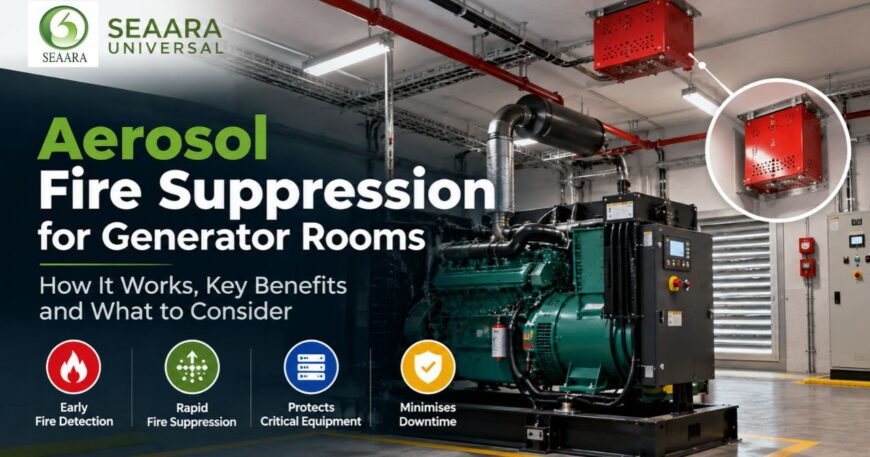
Can aerosol fire suppression for generator rooms protect a DG set during an unattended diesel leak or electrical fault? It can provide compact, water-free protection in suitable enclosed diesel generator rooms when detection, shutdown logic, fuel isolation, ventilation control and evacuation measures work together. A poorly selected system may still fail if fuel continues to flow, room openings leak agent, or hot exhaust parts cause re-ignition.
Aerosol fire suppression for generator rooms uses self-contained generators that release fine fire-suppressing particles after electrical, thermal or manual activation. It may suit enclosed generator rooms, acoustic canopies and adjoining electrical spaces, but it does not replace portable extinguishers, fire alarms, housekeeping or emergency response. Seaara Universal Private Limited supports hazard-led system selection, installation and lifecycle maintenance for Indian industrial facilities.
The following guidance covers hazards, operation, design choices, personnel safety, maintenance and Indian approval considerations.
Table of Contents
- Key Takeaways
- Why Fire Protection Is Important In Generator Rooms
- Common Fire Hazards In Generator Rooms
- What Is An Aerosol Fire Suppression System?
- Benefits And Limitations Of Aerosol Suppression
- Designing An Effective Generator-Room Suppression System
- Indian Standards And Compliance Considerations
- Installation, Inspection And Maintenance
- Frequently Asked Questions
- Can Aerosol Fire Suppression Be Retrofitted In An Existing DG Room?
- How Long Do Condensed Aerosol Fire Suppression Generators Last?
- What Should Happen If The Generator Room Layout Changes?
- Does Aerosol Fire Suppression Require Pressurised Cylinders?
- Can Aerosol Suppression Replace Fire Extinguishers Or Fuel Isolation?
- What Should A Generator-Room Aerosol System Proposal Include?
Key Takeaways
Aerosol protection works best when the generator room is treated as a connected fuel, electrical and ventilation risk, rather than a single equipment hazard.
Hazard-First Generator-Room Assessment reviews fuel lines, day tanks, exhaust heat, cable routes, room volume and access conditions. It also identifies leakage paths, equipment obstructions and local fire scenarios.
Chemical Chain-Reaction Interruption allows condensed aerosol to stop flame propagation without flooding the room with water. Fuel isolation and ventilation shutdown remain necessary because aerosol has limited cooling capacity.
Occupant Warning And Lifecycle Control require audible alarms, visible warnings, safe re-entry procedures and documented maintenance. Indian projects also need approved drawings, certificates, cause-and-effect records and authority acceptance.
Why Fire Protection Is Important In Generator Rooms
Generator-room fire protection aims to identify an emerging fire, limit escalation and protect standby power assets without avoidable damage to electrical equipment. Aerosol fire suppression for generator rooms can support this objective where the enclosure, fuel arrangements and operating conditions suit total-flooding protection.
Diesel generators combine ignition sources, flammable liquids, rotating machinery, batteries and electrical controls, often during a mains power failure. portable extinguishers remain necessary for trained first response, but they cannot provide continuous automatic protection in an unmanned DG room.
Common Fire Hazards In Generator Rooms
Fuel Leaks And Flammable Liquids
Diesel day tanks, transfer pumps, filters, hoses, return lines and pressurised sprays can create rapid pool or spray fires. Lubricating oil can also ignite after contacting turbochargers, exhaust manifolds or other hot engine surfaces.
Generator-room fire extinguishing system must work alongside fuel-pump shutdown, automatic valve isolation, drip containment and disciplined housekeeping. Otherwise, a released agent may suppress visible flames while the fuel source remains active.
Aerosol suppression should not be assumed to control every diesel pool fire or pressurised fuel-spray fire. Suitability must be confirmed for the specific hazard and the system’s tested applications. Fuel isolation, shutdown controls and measures to prevent re-ignition remain essential parts of the overall fire protection strategy.
Electrical Faults And Hot Surfaces
Alternators, battery chargers, automatic transfer switches, control panels, cable terminations and switchgear can produce arcing or overheating. Lead-acid batteries require adequate ventilation because charging can release hydrogen, while lithium-ion batteries need separate fire-engineering review. Exhaust assemblies can remain hot after a fire appears controlled.
Electrical fire protection must account for residual heat, concealed cable damage and possible re-ignition.
What Is An Aerosol Fire Suppression System?
An aerosol fire suppression system releases fine aerosol particles and active chemical species that help suppress combustion in a protected space. An aerosol fire suppression system is a fixed system that releases fine fire-suppressing particles from self-contained generators after activation. Aerosol fire suppression for generator rooms commonly uses a total-flooding approach, meaning the approved agent quantity must cover the protected enclosure volume.
Compact generators, limited pipework and aerosol suppression system can suit electrical and mechanical rooms with limited floor space. However, performance depends on enclosure integrity, ventilation control, discharge clearances, equipment compatibility and manufacturer-approved calculations.
How Condensed Aerosol Suppression Works
Condensed aerosol suppression uses a solid aerosol-forming compound that produces microscopic particles and gaseous components during a controlled reaction, a mechanism examined in research on condensed aerosol generators in building fire safety. The fine particles and active chemical species released by a condensed aerosol system suppress combustion primarily through chemical inhibition of the reactions that sustain a flame. The precise mechanism depends on the aerosol formulation and should be confirmed against the manufacturer’s technical documentation.
This is not water mist, foam or a conventional pressurised clean-agent system. It can control flames rapidly, but continuing fuel flow and residual exhaust heat may still cause re-ignition.
Activation Methods
Electrical activation normally follows confirmed detection through a releasing control panel and battery-backed circuits. Thermal activation may suit local heat exposure where the manufacturer permits that arrangement and clearance rules are met. Manual operation can provide supplementary emergency response, but unattended generator rooms still need automatic fire-suppression controls.
Benefits And Limitations Of Aerosol Suppression
Aerosol fire suppression systems can offer compact equipment and avoid the need for large pressurised-agent cylinders in suitable applications, but their effectiveness depends on hazard compatibility, enclosure conditions and correct system design. Their limitations are equally important: they provide limited cooling, rely on enclosure integrity and may leave fine deposits. Product-specific deposits, discharge temperature, clearance distances and compatibility with alternators, controls and cable insulation require manual model aerosol products before installation.
| Factor | Aerosol | Water Mist | Foam | Gas-Based Systems |
|---|---|---|---|---|
| Cooling Effect | Limited | High | Moderate | Limited |
| Water Or Residue Implications | Fine deposits may occur | Water exposure possible | Foam clean-up required | Usually minimal residue |
| Storage Footprint | Compact generators | Pumps and water supply | Tanks and proportioning equipment | Cylinders and pipework |
| Enclosure Dependence | High | Lower in some designs | Depends on application | High for total flooding |
| Fuel-Fire Suitability | Subject to tested approval | Often suitable for machinery risks | Strong for liquid pools | Subject to agent approval |
| Typical Generator-Room Use | Enclosed DG rooms and canopies | Larger machinery spaces | Fuel spill protection | Sealed electrical rooms |
Designing An Effective Generator-Room Suppression System
Effective generator-room suppression design starts with a documented hazard assessment, not a generic cartridge quantity or lowest-price proposal. Aerosol fire suppression for generator rooms needs coordinated detection, releasing logic, fuel shutdown, ventilation closure, warning devices and compliance records.
Total flooding also depends on sealed doors, cable penetrations, ducts, louvres and other openings that could release the agent. Continuous fuel flow, high-pressure sprays, deep-seated combustibles, large fuel loads and heavily ventilated rooms may require supplementary measures or another approved method.
Hazard Assessment And Equipment Selection
The hazard assessment must establish net protected volume, ceiling voids, raised floors, cable trenches, acoustic canopies, obstructions and adjacent compartments. It should also review fuel type, day-tank location, fuel-flow conditions, generator capacity, forced ventilation, hot surfaces and expected occupancy.
Agent quantity and generator placement must follow the selected manufacturer’s listed design method, never an informal coverage rule. Placement should address shadow areas around engines, alternators, pumps, cable trays and enclosure compartments.
Seaara Universal Private Limited uses a hazard-based review of enclosure volume, ventilation paths, equipment layout and process risks before aerosol suppression products, Micro Mist or a combined arrangement. This helps avoid placing hot-discharge equipment close to fuel lines, batteries or combustible acoustic materials.
Detection, Alarms And Personnel Safety
Detection should match the room environment and likely ignition source. addressable smoke detector can identify early electrical faults, while heat, rate-of-rise or flame detection may suit dusty, hot or fuel-risk locations. Detector selection, confirmation logic, release delays and manual controls should be established through the system design and hazard assessment. The arrangement must balance prompt fire response with personnel safety and the risk of unwanted discharge.
A cause-and-effect matrix should define fire alarm system, warning signals, release delay, generator shutdown, fuel isolation, ventilation shutdown, damper closure and aerosol discharge. Manual release stations should sit outside the protected room, while supervised abort controls must not permit indefinite disablement.
Audible and visual warnings, controlled ventilation after discharge and restricted re-entry protect personnel from reduced visibility, hot surfaces and hidden fire.
Indian Standards And Compliance Considerations
Indian documentation should cover room-volume calculations, equipment certificates, layouts, battery calculations, interface schedules, acceptance records and maintenance plans. Fixed aerosol fire suppression systems should be designed and installed in accordance with the applicable requirements of NFPA 2010, where relevant, the manufacturer’s approved design documentation and applicable Indian requirements. UL 2775 addresses fixed condensed aerosol extinguishing system units, but any product-specific certification or listing must be verified. The National Building Code of India, local fire authority requirements and project specifications should also be considered where applicable.
The authority having jurisdiction should confirm the latest applicable requirements, fire safety audit and acceptance process before procurement or installation.
Installation, Inspection And Maintenance
Installation, inspection and maintenance keep aerosol fire suppression for generator rooms available when a fault develops. Approved drawings should specify vibration-resistant mounting, protected release wiring, detector positions, warning devices, standby batteries and fire-alarm interfaces. Generators need the manufacturer’s stated orientation and clearances from fuel hoses, cable insulation, batteries, combustible surfaces and personnel routes.
Commissioning should test detection, alarms, manual release, abort controls, shutdown interfaces, fuel valves, dampers, ventilation, remote signals and fault monitoring without accidental discharge. Routine inspections should check generator casings, brackets, corrosion, wiring, detector condition, battery health, door closures, fuel leaks and ventilation alterations.
Seaara Universal Private Limited offers Annual Maintenance Contracts for inspection, testing and record-keeping. After discharge, isolate the room, confirm fuel shutdown and investigate the ignition source before entry. Personnel should assess the atmosphere, ventilate under controlled conditions, inspect for hot spots and clean deposits using equipment guidance, following occupational safety guidance on aerosol extinguishing systems such as the DGUV Information 205-043 health and safety sheet for personnel exposure after discharge. Discharged units and operated actuators require replacement, followed by complete system recommissioning.
Frequently Asked Questions
Generator-room aerosol questions usually concern retrofits, service life and room modifications. Aerosol fire suppression for generator rooms always needs manufacturer-approved engineering for the actual enclosure and equipment.
Can Aerosol Fire Suppression Be Retrofitted In An Existing DG Room?
Yes, retrofit may be possible after reviewing room volume, access, ventilation, clearances, wiring routes and shutdown interfaces. Open louvres, unsealed penetrations, fuel arrangements and limited mounting locations can require corrective work before installation.
How Long Do Condensed Aerosol Fire Suppression Generators Last?
Service life varies by manufacturer, generator model, storage environment and inspection requirements. Product documentation should define replacement intervals, permitted temperatures and inspection procedures. Every discharged generator requires replacement.
What Should Happen If The Generator Room Layout Changes?
Any change in generator size, fuel quantity, ventilation, cable routes, partitions, acoustic canopies or stored materials should trigger a design review. Changes can create shadow areas, increase leakage or alter discharge clearances.
Does Aerosol Fire Suppression Require Pressurised Cylinders?
Condensed aerosol systems typically store a solid compound within self-contained generators rather than large pressurised gas cylinders. This can reduce storage space and pipework needs in suitable rooms, but detection, releasing panels and maintenance remain necessary.
Can Aerosol Suppression Replace Fire Extinguishers Or Fuel Isolation?
No. Aerosol suppression does not replace ABC type extinguishers, fuel isolation, fire alarms, emergency procedures or other fire-protection measures required by the approved design and local authority.
What Should A Generator-Room Aerosol System Proposal Include?
A proposal should include a hazard review, room-volume calculations, equipment data, layout drawings, detector strategy, cause-and-effect matrix and shutdown interfaces. It should also state commissioning scope, maintenance support, exclusions and replacement arrangements.
Aerosol fire suppression for generator rooms can provide compact, water-free protection where enclosure conditions, fuel risks and equipment compatibility support its use. It must operate with early detection, generator shutdown, fuel isolation, ventilation control, evacuation warnings and disciplined post-discharge procedures.
NFPA 2010, UL 2775, National Building Code provisions, local authority requirements and project specifications should guide approval decisions. Seaara Universal Private Limited can assist with hazard-led design, installation, commissioning and ongoing maintenance for generator-room protection in India. Contact us to discuss your generator-room fire protection requirements.