
Could a loose connection inside a rack cause a business outage before a technician reaches the room? Could a suppression discharge protect equipment while creating recovery work? Aerosol fire suppression for server rooms can provide rapid flame suppression in appropriately designed and protected enclosures. Its suitability depends on the specific fire hazards, the system’s tested performance, equipment compatibility, occupant safety, detection and control arrangements, and the manufacturer’s installation requirements.
This article examines condensed aerosol technology, clean-agent and water-based alternatives, personnel safety, equipment recovery, Indian compliance, and lifecycle planning. Seaara Universal Private Limited provides aerosol and clean-agent options for facilities that require a hazard-based protection approach.
Key Takeaways
Aerosol fire suppression system for server rooms systems can suit defined, enclosed rooms with fast-growing electrical fire risks.
Detection, alarms, HVAC shutdown, and evacuation controls affect system performance.
Residue, battery hazards, approvals, commissioning, and maintenance need project-specific review.
Table of Contents
- Why Fire Suppression Is Critical for Server Rooms and Data Centers
- What Is an Aerosol Fire Suppression System and How Does It Work?
- Benefits of Aerosol Fire Suppression for Server Rooms Compared With Other Systems
- Is Aerosol Fire Suppression Safe for Server Rooms and How Should It Be Selected?
- Standards and Compliance Considerations in India
- The Bottom Line
- Frequently Asked Questions
Why Fire Suppression Is Critical for Server Rooms and Data Centers
Server-room fire safety addresses more than visible flames. Smoke, heat, and unplanned shutdowns can interrupt essential IT services. Aerosol fire suppression for server rooms is one option alongside clean agents, inert gases, CO₂, pre-action sprinklers, and water mist. The appropriate system depends on enclosure size, occupancy, equipment sensitivity, fire load, continuity requirements, and local authority conditions.
A small electrical event can damage servers, storage arrays, network switches, UPS equipment, aerosol suppression products before a room-wide fire develops. Smoke and corrosive combustion products may affect circuit boards and connectors far beyond the ignition source. Data center fire protection therefore requires early detection, controlled suppression, dependable electrical interfaces, and a practical post-discharge recovery plan.
Common Fire Risks in High-Density IT Environments
High-density IT rooms contain many ignition sources and combustible pathways within confined volumes. Electrical faults, overloaded PDUs, loose terminals, arc faults, overheated power supplies, cable insulation, and failed HVAC equipment can start a fire. UPS systems, lead-acid batteries, lithium-ion batteries, raised floors, ceiling voids, and cable trays need separate hazard review because they can conceal fire growth.
High airflow from computer-room air-conditioning units can move smoke away from its origin or delay detector response. Even a contained fire may leave soot, acidic residues, or water damage that delays restoration. Detection and suppression should cover room air, underfloor voids, ceiling spaces, and equipment zones where justified.
Types of Fire Suppression Systems for Server Rooms
Server-room protection usually uses layered measures rather than one universal extinguishing agent. Clean-agent systems, inert gas, CO₂, pre-action sprinklers, water mist, and condensed aerosol systems address different operational risks. Whether sprinklers or pre-action sprinkler systems are required depends on the building’s occupancy classification, applicable fire-safety provisions, project specifications, insurer requirements and approval conditions. Aerosol suppression should not be assumed to replace any independently required building fire-protection system.
| System | Residue | Storage Footprint | Occupied-Space Consideration | Typical Use |
|---|---|---|---|---|
| Condensed aerosol | Fine deposits possible | Compact | Occupant safety depends on agent, design, warning and evacuation arrangements | Selected enclosed electrical rooms and equipment enclosures, subject to approved design |
| Clean agent | Little or none | Cylinders and piping | Occupancy suitability depends on agent concentration, exposure limits and approved design | Suitable IT environments where the selected agent and design meet the project requirements. |
| Inert gas | None | Large cylinder banks | Oxygen concentration and exposure duration require assessment | Larger protected enclosures |
| CO₂ | None | Cylinders and piping | Significant asphyxiation hazard; strict occupancy safeguards required | Normally unmanned industrial hazards |
| Pre-action sprinklers | Water exposure possible | Piping and valves | Water exposure and building life-safety requirements must be considered | Data center building protection |
What Is an Aerosol Fire Suppression System and How Does It Work?
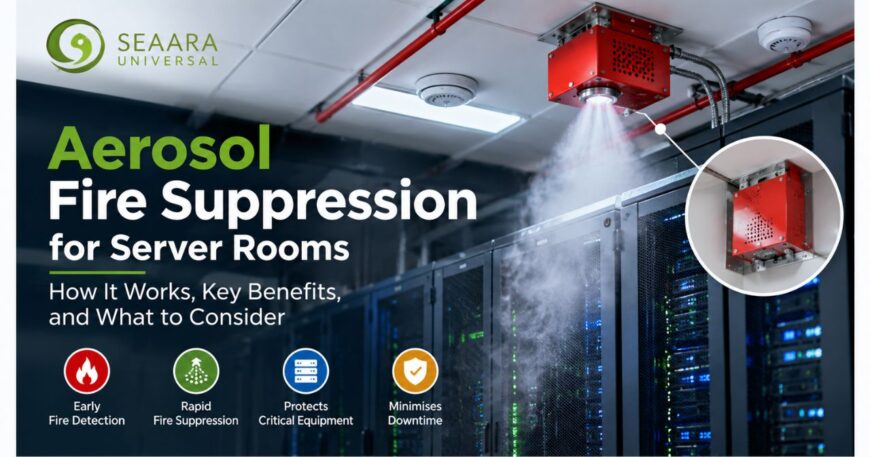
An aerosol fire suppression system releases fine particles that interrupt flame chemistry within a protected enclosure. Unlike clean-agent cylinders, aerosol fire suppression for server rooms stores a solid compound in compact generators. These generators activate through electrical, thermal, or manual controls. A complete installation includes detection, releasing controls, warning devices, HVAC interfaces, emergency procedures, and service records.
The system is generally designed as total-flooding protection for a defined room or enclosure. Generator quantity and placement must follow approved manufacturer calculations rather than generic assumptions about room volume. Rack obstructions, cable trays, airflow, raised floors, and discharge clearances all affect agent distribution.
What Condensed Aerosol Means and the Main System Components
Condensed aerosol fire suppression uses a solid aerosol-forming compound that creates microscopic extinguishing particles after activation. A typical generator contains the compound, an initiator, a cooling or filtering assembly, a housing, electrical terminals, mounting hardware, and safety labels. This solid-agent format reduces the need for high-pressure cylinders, manifolds, and extended pipe networks, an approach also seen in compact cabinet gaseous fire suppression systems designed specifically for server and network cabinet protection.
Fine aerosol differs from conventional dry chemical powder because its particles are smaller and intended to disperse through an enclosure. Condensed aerosol systems can leave fine deposits on surfaces and equipment. The amount and effects of residue depend on the formulation, discharge conditions, protected equipment and installation design. Compatibility should be confirmed with the aerosol-system manufacturer and relevant equipment manufacturers, particularly for optical devices, filters, fans, connectors and circuit boards. Seaara Universal Private Limited offers pressure-less core condensed aerosol systems with electrical, manual model aerosol products.
How Aerosol Particles Interrupt Combustion
Aerosol particles suppress flames primarily through chemical inhibition. In potassium-based condensed aerosol systems, active potassium-containing species interfere with the chain reactions that sustain combustion. The precise reaction mechanisms depend on the aerosol formulation and should be confirmed against the manufacturer’s technical documentation. Heat absorption and limited local oxygen reduction may contribute, but oxygen displacement is not the main extinguishing action.
A typical release sequence starts with early detection and progresses to a confirmed alarm, pre-discharge warning, evacuation delay, HVAC shutdown, generator activation, and discharge confirmation. Cross-zoned detection or other approved releasing logic may help reduce unwanted system activation. The detection arrangement, pre-discharge warnings, evacuation delay, manual release, abort controls where permitted, alarm devices, BMS signals and electrical shutdown interfaces should follow the approved cause-and-effect matrix for the installation. Manual release, abort functions, addressable sounder beacon, BMS signals, and selective electrical shutdown should follow a documented cause-and-effect matrix.
Benefits of Aerosol Fire Suppression for Server Rooms Compared With Other Systems
Aerosol fire suppression offers compact, rapid protection for selected enclosed technical spaces, but it does not suit every data center environment. Compared with cylinder-based systems, aerosol fire suppression for server rooms can reduce piping and storage demands during retrofits. Designers must also consider residue, visibility, heat near generators, enclosure integrity, and post-discharge recovery.
Aerosol technology can be appropriate where technical rooms are small, sealed, intermittently occupied, or difficult to retrofit with cylinder banks. It can protect equipment zones without releasing water directly onto electronics. Large, frequently occupied data halls with very low contamination tolerance may favor clean-agent or water-mist arrangements.
Benefits of Aerosol Fire Suppression for Compact Technical Spaces
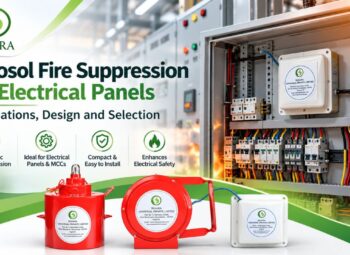
Compact generators can be wall-mounted, ceiling-mounted, or installed within suitable technical enclosures under approved design limits. This can reduce construction disruption in operating server rooms, electrical panels, switchgear rooms, UPS rooms, generator rooms, cable tunnels, and telecommunications facilities. Correctly located generators can disperse agent around racks, cabinets, and energized equipment that is difficult to access.
Condensed aerosol generators generally store the aerosol-forming compound as a solid rather than as a pressurised extinguishing agent. Although routine cylinder-pressure checks may not apply to these generators, the complete system still requires inspection of generators, mounting arrangements, electrical circuits, detectors, alarms and control interfaces according to the manufacturer’s maintenance instructions. Generators, releasing circuits, detectors, brackets, alarms, and interfaces still require scheduled inspection. Aerosol is generally more suitable for small or medium sealed rooms than an entire large data hall.
Aerosol Fire Suppression vs. Clean-Agent, CO₂, and Sprinkler Protection
Aerosol, clean-agent, CO₂, and sprinkler protection differ in residue, cooling, life safety, and restoration requirements. Clean agents such as FM-200 flooding system, Inergen, NAP S-III, and Novec 1230 generally leave little or no residue and may suit sensitive, occupied IT environments. However, occupant safety, allowable exposure, agent concentration, enclosure integrity and the manufacturer’s approved design must be evaluated for each installation. Suitability should not be assumed solely from the agent name. CO2 fire extinguishers can suppress electrical fires effectively but creates serious life-safety risks in normally occupied server rooms.
| Factor | Aerosol | Clean Agent | CO₂ | Pre-Action Sprinkler |
|---|---|---|---|---|
| Piping Need | Limited | Usually required | Usually required | Required |
| Residue | Fine deposits possible | Little or none | None | Water exposure possible |
| Cooling Effect | Limited | Limited | Limited | Stronger cooling |
| Recovery Work | Inspection and cleaning | Usually lower | Safety review required | Drying and restoration |
| Common Application | Compact enclosures | Sensitive IT rooms | Unmanned industrial spaces | Building-level protection |
Water mist can provide stronger cooling where residual heat or larger hazard volumes are a concern. Seaara Universal Private Limited designs, installs, and commissions FM-200, Inergen, NAP S-III, and Novec 1230 systems alongside aerosol options, allowing system selection based on the likely fire scenario.
Is Aerosol Fire Suppression Safe for Server Rooms and How Should It Be Selected?
Aerosol fire suppression can be safe for server rooms when the room, equipment, occupants, and release sequence have been properly assessed. Aerosol fire suppression for server rooms should not replace prevention, detection, compartmentation, electrical maintenance, or emergency response. A documented fire-risk assessment should guide technology selection before procurement.
Selection starts with protected volume, fire hazards, occupancy pattern, equipment sensitivity, ventilation arrangement, and regulatory requirements. The assessment should cover raised floors, ceiling voids, cable penetrations, lithium-ion battery risks, and probable fire-growth paths. A qualified fire professional should review the generator layout and recovery procedure before installation.
Where lithium-ion batteries or battery energy-storage systems are present, assess the battery installation as a distinct fire hazard. A system intended to suppress flames in an electrical enclosure should not automatically be treated as protection against battery thermal runaway, propagation or re-ignition. Battery-specific detection, thermal management, ventilation and emergency-response measures may be necessary.
Occupant Safety, Equipment Compatibility, and Post-Discharge Recovery
Aerosol discharge can reduce visibility and may irritate eyes or lungs. Occupants must follow the approved evacuation procedure, including any pre-discharge warning and delay sequence specified by the system design and applicable requirements. Aerosol discharge should not be assumed safe for occupants simply because the protected room is small or the system is automatically activated. Pre-discharge alarms, visual indicators, emergency lighting, warning signage, evacuation delays, addressable manual call point, and properly designed abort controls are necessary safeguards. HVAC shutdown, damper closure, sealed penetrations, and self-closing doors help retain the agent in the protected zone.
Equipment must remain isolated until authorized personnel investigate the fire and confirm safe re-entry conditions. Recovery normally includes:
Controlled ventilation and concealed-fire checks
Inspection of racks, cable spaces, and affected components
Cleaning where deposits are present
Generator replacement and return-to-service testing
Aerosol suppression may help control flaming combustion during some lithium-ion battery incidents, but it should not be assumed to stop the internal thermal runaway process or prevent re-ignition. Battery-related fire protection requires a hazard-specific assessment covering battery chemistry, detection, thermal management, ventilation, propagation risk and the manufacturer’s emergency procedures. Battery rooms need dedicated monitoring, cooling, ventilation, and manufacturer-specific procedures.
Selecting, Installing, and Maintaining an Aerosol Fire Suppression for Server Room System
System selection requires evaluation of gross and net volume, operating temperature, leakage paths, rack arrangement, cable loading, fire load, HVAC airflow, and protected voids. Generator quantity, location, direction, clearances, and activation method must follow the manufacturer’s approved design manual. Aspirating addressable smoke detector, releasing panels, sounders, strobes, BMS interfaces, access control, and coordinated electrical isolation should operate as one fire detection and suppression arrangement.
Commissioning should test detection zones, release logic, alarm signals, manual release, abort operation, HVAC controls, circuit supervision, fault conditions, and emergency interfaces without an unauthorized live discharge. Procurement records should cover approvals, service life, replacement access, safety data sheets, residue expectations, installation limits, and local service capability. Seaara Universal Private Limited provides lifecycle support through inspection, testing, records, integrity checks, and post-discharge generator replacement under Annual Maintenance Contract services.
Standards and Compliance Considerations in India
Indian aerosol fire suppression projects require confirmation that the complete system and its intended application meet applicable standards and approval conditions. A listed generator alone does not establish that a server-room design is acceptable. Fire consultants, electrical engineers, HVAC engineers, facility operators, insurers, and the authority having jurisdiction should coordinate early.
Compliance reviews should examine enclosure boundaries, occupancy, ventilation shutdown, pressure effects, detection logic, electrical interfaces, and emergency-response procedures. Local fire NOC conditions can vary by municipality, building classification, and facility type. Industrial sites may also have owner standards and process-safety requirements.
Applicable Standards, Approvals, and Documentation
Applicable standards and approvals should be identified for the specific aerosol suppression system, protected hazard and installation location. Relevant references may include NFPA 2010 for fixed aerosol fire-extinguishing systems and NFPA 72 for fire alarm and signalling functions, where applicable. In India, the project team should also assess relevant National Building Code of India provisions, applicable Indian Standards, local fire authority conditions, insurer requirements and manufacturer-approved design documentation. Additional requirements may apply to petroleum and other specialised industrial facilities. Any claimed certification or listing must be verified for the specific product, system configuration and intended application.
Project documentation should verify the listing scope, approved hazard types, design concentration, temperature limits, discharge clearances, occupancy restrictions, service life, transport data, and disposal instructions. Handover records should include as-built drawings, design calculations, cause-and-effect matrices, certificates, manuals, commissioning reports, emergency procedures, and maintenance schedules.
Why System Design and Certification Must Be Verified
A compliant installation accounts for enclosure integrity, ventilation, pressure relief, underfloor spaces, ceiling voids, rack obstructions, and generator discharge clearance. Treating a listed component as proof of whole-system compliance can leave gaps in coverage or life-safety controls. Room modifications, new cable routes, altered HVAC settings, and changed battery equipment may require a new engineering review.
Common errors include leaving HVAC fans running, overlooking raised floors, ignoring battery thermal runaway, and mounting generators too close to equipment. Seaara Universal Private Limited supports design, supply, installation, testing, and commissioning for aerosol, clean-agent, fire alarm system, BMS, and related fire protection systems in India. Final acceptance should rest on approved product data, project documentation, and authority requirements.
The Bottom Line
Aerosol fire suppression for server rooms can be a strong option for compact, enclosed, electronics-rich spaces where rapid flame suppression and a limited installation footprint matter. Its performance depends on room integrity, early detection, HVAC control, safe evacuation, correct generator placement, and disciplined post-discharge recovery. It may protect selected rooms or enclosures within a larger data center rather than the entire facility.
Before procurement, compare aerosol with clean-agent, water mist, inert gas, and pre-action protection against the actual hazard and continuity objective. A documented fire-risk assessment and code-aligned commissioning plan provide a sound basis for the decision. Seaara Universal Private Limited can assist project teams with hazard-based system selection, installation, and lifecycle maintenance.
Frequently Asked Questions
The following FAQs address common questions about aerosol fire suppression for server rooms, including suitability, equipment compatibility, system selection and maintenance.
How Does Aerosol Fire Suppression For Server Rooms Work?
Aerosol suppression releases fine particles from an activated solid compound. Those particles interrupt the combustion chain reaction and suppress flaming fire. Performance depends on enclosure integrity, generator design, detection logic, and ventilation control.
Can Aerosol Systems Protect Server Rooms?
Aerosol systems can protect selected server rooms, telecommunications spaces, control rooms and electrical enclosures when the particular system is appropriately designed, tested and approved for the application. Occupancy, leakage, airflow, equipment sensitivity, and approvals determine suitability. Larger data centers may use aerosol only in selected zones.
Will Aerosol Discharge Damage IT Equipment?
Aerosol avoids direct water damage but may leave fine deposits that require inspection and cleaning. Compatibility should be checked for optical devices, filters, circuit boards, and sensitive connectors. Equipment should not be re-energized until recovery procedures are complete.
How Does Aerosol Fire Suppression for Server Rooms Compare With Clean-Agent Systems?
Aerosol uses compact pressure-less solid-agent storage, while clean agents generally leave little or no residue. Clean-agent systems may suit occupied rooms and highly residue-sensitive IT environments. Hazard assessment, lifecycle cost, approvals, and recovery objectives should guide selection.
Can an Aerosol System Be Installed Inside an Electrical Enclosure?
Yes, compact aerosol units can protect suitable electrical panels, control cabinets, and switchgear enclosures. Designers must verify volume, electrical clearances, mounting position, activation method, and manufacturer limits. Detection, alarm signaling, and maintenance procedures remain necessary.