

Aerosol vs Water Mist Fire Suppression for Industry
Aerosol vs Water Mist Fire Suppression for Industry is more than a search phrase; it is a life‑safety decision. Pick the wrong system and a single fire can stop production, damage assets, and bring regulatory trouble. The choice between aerosol and water mist affects compliance, downtime, insurance, and worker safety.
Many safety teams feel stuck because both systems look modern and clean compared with CO₂ or halon substitutes. Vendor brochures talk about features, not about how each option behaves inside real machinery spaces, control rooms, or refineries. Standards such as NFPA 750, NFPA 2010, OISD, and UL add technical detail to an already heavy decision.
In this article, we explain how each technology works, where each one fits, and which performance parameters matter most. We compare aerosol and water mist across suppression mechanism, application, regulatory standards, and lifecycle cost. We also show how Seaara Universal Private Limited uses structured fire audits and hazard studies to recommend the right mix for industrial plants.
The aim is simple: give you a clear, facility‑focused decision framework that you can present with confidence to management and regulators.
Key Takeaways
- Mechanism matters. Water mist relies mainly on cooling, oxygen reduction, and blocking radiant heat, while aerosol focuses on chemical interruption of the flame. This difference guides correct system selection.
- Typical applications differ. Water mist suits larger, infrastructure‑ready spaces such as turbines, machinery halls, data centers, and commercial buildings. Aerosol fits compact, sealed spaces such as cabinets and control rooms.
- Codes drive design. NFPA 750 guides water mist, while NFPA 2010 and UL 2775 guide condensed aerosol units. FM Global and UL listings give insurers and Authorities Having Jurisdiction confidence in your design.
- Dual‑technology expertise helps. A provider that understands both aerosol and water mist can compare them honestly for each hazard zone. At Seaara Universal Private Limited, we combine 4G Aerosol Suppression with Micro Mist experience to support that kind of side‑by‑side discussion.
- Start from your hazard profile. Enclosure volume, ventilation, water availability, asset value, and local codes matter more than catalog pages. Our team uses structured fire audits and maintenance planning to build a long‑term, workable suppression strategy.
“The primary goal of any fire protection system is to control a developing fire or extinguish it, thereby protecting life and property.” — National Fire Protection Association (NFPA)
How Do Aerosol And Water Mist Fire Suppression Systems Actually Work?

Aerosol and water mist fire suppression systems work on different physical and chemical principles. Water mist mainly cools and changes the atmosphere around the fire, while aerosol disrupts the flame chemistry inside that atmosphere.
Water mist fire suppression systems push water through special nozzles to create very small droplets. According to NFPA, NFPA 750 defines water mist as a spray where 99 percent of the volume is in droplets under 1,000 microns. These droplets absorb heat, turn to steam, displace oxygen near the flame, and form a partial shield against radiant heat — behaviours shaped by the aerosol and cloud physics principles catalogued in Harmonized aerosol size distribution, cloud condensation nuclei, and optical properties research that quantifies how fine particle populations interact with heat and light in suppression-relevant conditions. Systems can run at low, medium, or high pressure, with high pressure usually giving the finest droplets.
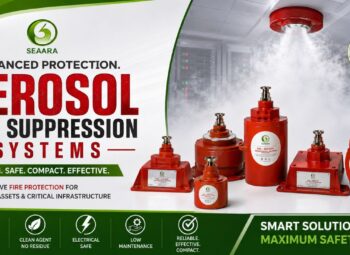
Condensed aerosol systems use a solid chemical charge inside compact generators. When triggered by a detection signal or a built‑in thermal link, that charge reacts and throws out a cloud of very fine potassium‑rich particles mixed with gases. The particles react with free radicals in the flame, breaking the chain reactions that keep combustion going. NFPA 2010 and UL Standard 2775 describe how fixed aerosol units must be built and tested.
A key difference is infrastructure. Water mist usually needs pumps, pipework, and a water source sized to the hazard. Aerosol generators sit inside or near the risk zone with no piping and no water. As a result, water mist performs better in larger enclosures that can support a network, while aerosol excels in small sealed volumes where a fixed concentration is easy to achieve.
Which Industrial Environments Are Best Suited To Each System?

Industrial environments suit aerosol and water mist very differently because fire loads, enclosure sizes, and occupancy levels change from zone to zone. Water mist usually works better in larger machinery and process areas, while aerosol suits compact, enclosed, often unmanned spaces.
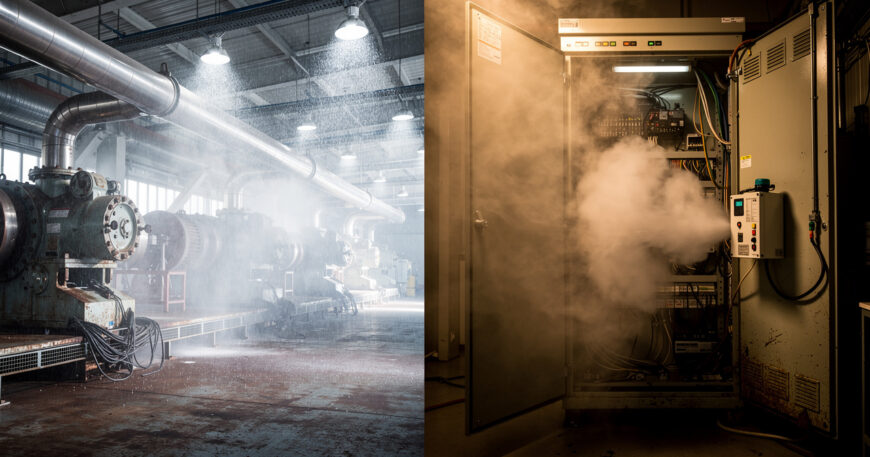
Water mist fits machinery spaces, power‑generation turbine halls, and large data centers where sensitive equipment shares space with high‑heat sources. Large‑scale tests under FM Global Approval Standard 5560 show that water mist can protect machinery spaces and turbines while using a fraction of the water used by sprinklers. In road tunnels and vehicle decks, research cited by NFPA shows that mist helps control multi‑vehicle fires and improves visibility for evacuation. In commercial towers and mixed‑use buildings, mist improves asset protection compared with sprinklers because total water volume is much lower.
Aerosol systems work best in clean, enclosed volumes such as electrical switch rooms, control cabinets, generator enclosures, and remote telecom shelters. Studies referenced by NIST highlight that aerosol performance depends heavily on achieving a design concentration and keeping it in place. That makes aerosol attractive for sealed volumes on offshore platforms, refinery control rooms, or skid‑mounted equipment rooms where pipe routing is difficult and space is tight.
Personnel exposure also matters. Water mist is considered safe in occupied areas when designed correctly and is accepted by NFPA 750 for such use. Aerosol fumes and particulates can irritate the respiratory tract, so NFPA 2010 treats most fixed aerosol systems as options for normally unoccupied or quickly evacuated spaces. We stress this distinction when we help clients plan alarm logic and egress.
How Does Seaara Universal Private Limited Match The Right Technology To Your Facility?
At Seaara Universal Private Limited, we start with a fire audit rather than a product pitch. Our engineers map each zone by enclosure volume, ventilation paths, equipment layout, and process hazards before we even discuss aerosol or Micro Mist options.
Because we have deep experience with 4G Aerosol Suppression Systems and Micro Mist systems, we can speak from both sides. In a petroleum refinery, we may recommend water mist for pump bays and loading racks, while specifying aerosol inside electrical control panels and remote analyzers. In a data‑heavy commercial campus, we often pair Micro Mist for white‑space protection with aerosol inside individual UPS cabinets.
Our ISO 9001‑certified processes cover design, sourcing, installation, commissioning, and Annual Maintenance Contracts. That means we share responsibility for the decision with you, from NFPA and OISD compliance at design stage to service records that stand up during inspections.
What Are The Key Performance Parameters That Determine Suppression Effectiveness?

Key performance parameters for aerosol and water mist decide whether a design will stop a real industrial fire. For water mist, droplet size, pressure, flow, and enclosure height shape how fast the fire cools and how much oxygen is displaced. For aerosol, agent concentration, enclosure leakage, and activation speed set the success window.
Water mist design starts with droplet size. Research summarised by the Society of Fire Protection Engineers shows that droplets in the ranges of 100–250 microns and 550–1,000 microns perform well for many scenarios. Smaller droplets evaporate quickly and pull out heat, while larger ones punch through the flame plume. Operating pressure and nozzle type fix the actual size distribution, so high‑pressure systems from providers such as Seaara Universal Private Limited (Micro Mist), Marioff HI‑FOG, Danfoss SEM‑SAFE, or Tyco AquaMist are often used where very fine droplets are required.
Ceiling height and ventilation are just as important. Data referenced in NFPA 750 indicate that deluge‑style water mist is reliable up to about 9.1 meters of ceiling height, while closed‑head mist is often limited to around 6.1 meters. Above those heights, droplets may evaporate or slow before reaching the fire. Ventilation fans and open doors can strip away mist and bring in fresh oxygen, lowering effectiveness if not factored into the design.
For aerosol, the starting point is agent mass per cubic meter of protected volume. NFPA 2010 requires designs to reach a minimum concentration and hold it long enough to secure extinguishment. Leakage paths through ducts, cable penetrations, or ill‑fitting doors reduce this hold time, so tightness testing becomes part of commissioning — an approach backed by research such as the Numerical Study on Fire suppression by water mist in aircraft cargo compartments, which demonstrates how spray pattern, droplet size, and enclosure integrity together determine suppression success. Because aerosol gives limited cooling, we also pay close attention to fuel type and residual heat so that hot surfaces do not allow reignition once the cloud decays.
How Do Regulatory Standards And Compliance Requirements Shape System Selection?

Regulatory standards largely determine which aerosol or water mist system is acceptable for an industrial facility. For many operators, NFPA, FM Global, UL, and local rules are the hard guardrails that frame the technical discussion. Within India, OISD, ISI, CE, and UL marks sit beside those international standards and influence almost every fire project in petroleum and chemical sectors.
Water mist systems in the United States follow NFPA 750, which defines how to design, install, test, and maintain these systems, and the underlying droplet physics are further illuminated by research on Fig. 2: Relationships between particle size distribution and liquid water content per droplet across regions, which helps engineers validate nozzle specifications against code-required droplet classifications. According to NFPA, NFPA 750 groups water mist into three classes by droplet size, with Class 1 defined as 90 percent of the volume in droplets at or below 200 microns. FM Global Approval Standard 5560 then sets extra rules for machinery spaces, turbines, light‑hazard occupancies, and other uses, which many insurers require for policy acceptance.
Condensed aerosol systems follow NFPA 2010 and UL 2775, which cover everything from unit construction to design concentration and maintenance checks. These documents recognise aerosol as a total‑flooding agent that relies on room integrity, much like clean agents. Authorities Having Jurisdiction expect to see hardware carrying these listings for the specific hazard type, not just a general rating.
For Indian industrial facilities, especially refineries and chemical plants, OISD standards add another layer to NFPA guidance. ISI, CE, and UL marks validate that components meet both local and international benchmarks. At Seaara Universal Private Limited, we deliberately source and commission systems that satisfy NFPA or FM Global rules while also staying in line with OISD and ISI demands, so safety managers are not caught between code bodies during audits.
Aerosol Vs Water Mist: A Side-By-Side Comparison For Industrial Decision-Makers

Aerosol vs water mist comparisons become easier when key criteria sit in a single view. Both are advanced systems, yet neither is right for every setting. The real aim is to match each option to each hazard zone.
| Criterion | Water Mist System | Condensed Aerosol System |
|---|---|---|
| Suppression Path | Physical cooling, oxygen reduction, radiant heat shielding | Chemical flame inhibition with some inerting |
| Water Use | Very low compared with sprinklers; needs water source | No water needed |
| Infrastructure Need | Pumps, stainless piping, special nozzles | Compact generators, no piping, small footprint |
| Best Enclosure Size | Medium to large volumes such as halls and machinery rooms | Small to medium sealed rooms and cabinets |
| Personnel Safety | Suitable for occupied spaces when designed to NFPA 750 | Usually for unoccupied or fast‑evacuated spaces |
| Cooling And Reignition Control | Strong surface and gas cooling; low reignition risk | Limited cooling; focus on flame knockdown |
| Residue After Discharge | Light water film; minimal cleanup | Fine particulate residue needing careful cleaning |
| Main Standards | NFPA 750, FM 5560, UL listings | NFPA 2010, UL 2775, related approvals |
| Typical Industrial Uses | Turbines, engine rooms, data halls, commercial floors | Switchgear rooms, control panels, generator sets, remote skids |
According to Engineering Toolbox, water absorbs about 2,260 kilojoules per kilogram when it turns to steam, which explains why mist has such a strong cooling effect — a phenomenon also explored in research on The Impact of Water-Based fire suppression systems on combustion products, which confirms how water’s thermodynamic properties directly shape the byproducts and effectiveness of suppression events. By contrast, aerosol relies primarily on chemical action, so it stops flames fast but can leave hot metal behind if the fuel load is high — a residual heat challenge documented in studies such as the Effect of Sophorolipid-Containing Fine water mist on fire smoke diffusion, which highlights why combining chemical suppression agents with cooling mechanisms can be critical in high-heat tunnel and enclosed environments.
At Seaara Universal Private Limited, we often recommend a hybrid strategy for complex industrial campuses. For example, a power plant may use water mist in turbine enclosures and cable basements, then deploy aerosol inside generator control cabinets and remote panels. Our one‑stop model, which covers design, installation, NOTIFIER USA alarm integration, Annual Maintenance Contracts, and trained firefighting manpower, lets safety managers run this mix without juggling multiple vendors.
The Bottom Line: Let Your Facility’s Hazard Profile Drive The Decision
The better system for any facility comes from its hazard profile, not from a generic ranking. Enclosure size, fire load, water availability, personnel occupancy, and code demands should point clearly toward water mist, aerosol, or a measured blend of both. When we walk clients through this matrix, the choice usually becomes far less confusing.
Conclusion
Aerosol and water mist fire suppression systems both go far beyond older agents and standard sprinklers for many industrial sites. Water mist offers strong cooling, low water damage, and proven performance in larger machinery and building volumes. Aerosol provides compact, water‑free protection for sealed electrical and mechanical spaces.
The safest industrial strategies often mix these technologies while staying within NFPA, FM Global, OISD, ISI, CE, and UL frameworks. Seaara Universal Private Limited combines 4G Aerosol Suppression, Micro Mist expertise, and full lifecycle services to help you design, install, and maintain the right combination for each zone. When the next fire challenge comes, a code‑aligned, hazard‑based choice is what keeps assets, people, and production safe.
Frequently Asked Questions
Question 1: Can Aerosol Suppression Systems Be Used In Occupied Industrial Spaces?
Aerosol suppression systems are generally not intended for occupied industrial spaces during discharge. The particulate cloud can irritate eyes and lungs and sharply reduce visibility. NFPA 2010 treats these systems mainly for normally unoccupied or quickly evacuated areas. In contrast, water mist systems designed under NFPA 750 can protect spaces where people remain during activation, provided warning and egress are carefully planned.
Question 2: Is Water Mist Safe For Electrical Equipment And Data Centers?
Yes, properly engineered water mist is considered safe for electrical equipment and data centers. Research cited by NFPA and major vendors such as Tyco and Danfoss shows that fine mist does not cause harmful leakage currents at design distances. It also cools overheated cables and plastic insulation faster than most gas agents, cutting the chance of reignition.
Question 3: What Is The Difference Between Aerosol Suppression And CO₂ Systems?
The main difference is how they stop the fire. CO₂ suppresses almost entirely by reducing oxygen concentration, which can be deadly for anyone left inside the space. Aerosol interrupts the flame chemistry using fine particles, with some additional inerting, and does not need high‑pressure cylinders or large pipe networks. Both methods depend on room tightness and careful safety interlocks.
Question 4: How Often Do Aerosol And Water Mist Systems Require Maintenance?
Both aerosol and water mist systems require regular maintenance on a defined schedule. Water mist systems need nozzle checks, strainer cleaning, pump inspection, and periodic pipe flushing to keep fine orifices clear. Aerosol generators need visual inspection, integrity checks, and replacement after any discharge. Seaara Universal Private Limited offers Annual Maintenance Contracts that cover inspection, testing, and record keeping for both technologies.
Question 5: What Compliance Standards Apply To Fire Suppression Systems In Indian Industrial Facilities?
Indian industrial facilities follow a mix of local and global fire standards. OISD guidelines apply strongly to petroleum and gas sectors, while ISI marks, CE marking, and UL listings support system acceptance across many industries. When we supply aerosol or Micro Mist systems, Seaara Universal Private Limited selects components and designs that align with these frameworks so audits and insurer reviews run smoothly.