

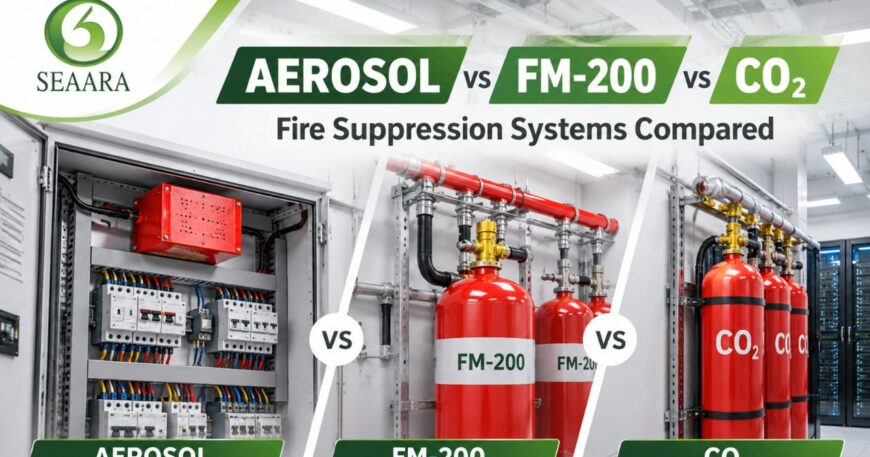
Industrial fire protection can fail when a system is chosen by agent type rather than the actual hazard. Aerosol Fire suppression vs FM-200 is not a universal contest, and CO₂ belongs only in applications with strict life-safety controls.
Condensed aerosol can fit compatible localized enclosures, FM-200 can fit enclosed equipment rooms requiring clean recovery, and CO₂ can suit selected electrical or flammable-liquid hazards with controlled occupancy. Seaara Universal Private Limited provides hazard-based fire protection support across these technologies, from design through commissioning and maintenance.
The following comparison examines mechanisms, infrastructure, cleanup, safety, maintenance, applications, and code-related selection factors.
Key Takeaways
The correct fire suppression system depends on the enclosure, fuel, ventilation, occupancy, and recovery needs. Initial purchase cost alone rarely reflects the full operational impact after a discharge.
Condensed aerosol is commonly used for compact, enclosed hazards such as electrical panels, MCCs, cable tunnels, and machinery compartments. It uses a solid generator and may leave fine particulate residue. Equipment compatibility and cleanup planning matter before specification.
FM-200 supports rapid, clean-agent protection in enclosed rooms containing sensitive electronics. It requires cylinders, piping, nozzles, room integrity, and releasing controls. Properly designed FM-200 systems may be used in normally occupied spaces where applicable concentration limits, detection, alarm, egress and safety requirements are satisfied.
CO₂ remains relevant for selected electrical and flammable-liquid risks. It reduces oxygen concentration, so alarms, lockout procedures, evacuation, and restricted access are mandatory. A documented engineering review should guide every final choice.
Table of Contents
- What Are Aerosol, FM-200, and CO₂ Fire Suppression Systems?
- Aerosol Fire Suppression vs FM-200 vs CO₂: Key Differences At A Glance
- Which Applications Favor Aerosol, FM-200, Or CO₂ Fire Suppression?
- Which Fire Suppression System Should You Choose?
- The Bottom Line
- Frequently Asked Questions
What Are Aerosol, FM-200, and CO₂ Fire Suppression Systems?
Aerosol, FM-200, and CO₂ systems control fire through different physical and chemical methods. The aerosol fire suppression vs FM-200 decision begins with how each agent is stored, discharged, and retained around the hazard. Condensed aerosol suppresses combustion primarily by interfering with the chemical reactions that sustain the flame., FM-200 uses pressurized HFC-227ea cylinders, and CO₂ uses pressurized carbon dioxide cylinders. Each system needs compatible detection, releasing controls, alarms, shutdown interlocks, and maintenance procedures.
How Does Condensed Aerosol Fire Suppression Work?
Condensed aerosol fire suppression uses a solid aerosol-forming compound that releases fine particles and gases after activation. The aerosol fire suppression vs FM-200 comparison may favor aerosol where a compact arrangement fits the protected enclosure. Fine particles suppress combustion primarily by interrupting flame chemistry, converting unstable flame free radicals into more stable compounds and slowing the reaction that sustains flame, a mechanism examined in research on aerosol extinguishing agent effectiveness against battery vent gases and hydrogen.
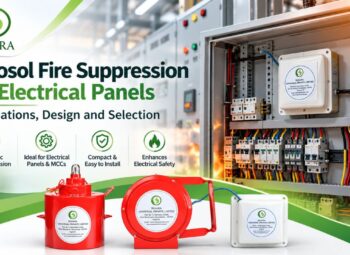
Seaara Universal Private Limited offers electrically operated, manually operated, and thermally operated aerosol generators for compatible hazards. These units can protect aerosol suppression products for electrical panels, MCCs, LT and HT panels, UPS rooms, switchgear compartments, cable tunnels, and enclosed machinery. For broader technical guidance, review the Seaara aerosol fire suppression pillar page and relevant aerosol suppression product pages.
How Do FM-200 and CO₂ Suppress a Fire?
FM-200 is heptafluoropropane, also called HFC-227ea, stored as a pressurized liquefied clean agent. In an aerosol fire suppression vs FM-200 review, FM-200 is typically considered for suitable enclosed rooms that require clean-agent recovery. It absorbs heat and interrupts combustion chemistry. Engineered total-flooding systems are designed to discharge the required agent concentration within the time specified by the applicable system design and standard..
CO₂ is a high-pressure gaseous agent that suppresses fire largely by reducing oxygen around the flame. That mechanism can be effective for selected hazards, yet it creates severe personnel-exposure concerns in enclosed or occupied spaces. Seaara Universal Private Limited provides FM-200 flooding systems, CO₂ systems, installation, commissioning, and maintenance support for projects requiring engineered protection.
Aerosol Fire Suppression vs FM-200 vs CO₂: Key Differences At A Glance
Aerosol, FM-200, and CO₂ differ most in discharge method, residue profile, and life-safety conditions. The aerosol fire suppression vs FM-200 choice should reflect the protected volume and recovery objective, while CO₂ requires separate scrutiny for oxygen-deficient-atmosphere risks. None of these agents can protect a poorly defined hazard or compensate for uncontrolled ventilation, continuing fuel release, or inadequate detection.
Comparison Table: Agent, Infrastructure, Cleanup, And Safety
The table below provides a fast screening view for aerosol, FM-200, and CO₂ systems. It does not replace hydraulic calculations, enclosure review, product listing verification, or approval by the authority having jurisdiction.
| Selection Factor | Condensed Aerosol | FM-200 | CO₂ |
|---|---|---|---|
| Extinguishing method | Primarily interrupts flame chemistry | Heat absorption and chemical interruption | Oxygen displacement |
| Agent form | Fine particles and gases | Liquefied clean agent | Compressed gas |
| Storage | Solid generator | Pressurized cylinder | Pressurized cylinder |
| Piping need | Often minimal for localized hazards | Typically required | Usually required |
| Residue | Fine particles may remain | No conventional residue | No conventional residue |
| Electronics | Product compatibility review needed | Commonly suitable for sensitive equipment | May be suitable with discharge safeguards |
| Occupancy | Exposure and re-entry review required | Occupancy depends on design concentration and applicable safety requirements | Strict controls required |
| After discharge | Generator replacement and cleanup | Inspection and professional recharge | Inspection and professional recharge |
Aerosol generators are generally replaced after discharge, while FM-200 and CO₂ cylinders require professional recharge or replacement. FM-200 and CO₂ leave no conventional residue, but responders still need to inspect equipment, ventilate the enclosure, and identify the ignition source.
Safety, Environmental, And Operational Trade-Offs
Aerosol suppresses flame without significantly reducing oxygen, but discharge products, visibility, exposure limits, and re-entry procedures still need review. In an aerosol fire suppression vs FM-200 selection, the facility must account for sensitive contacts, optical equipment, exposed metals, and post-discharge cleaning procedures.
FM-200 may protect normally occupied spaces when concentration limits, alarms, evacuation procedures, and system controls meet applicable requirements, consistent with engineered system design and installation manuals covering total flood fire suppression requirements. CO₂ demands more restrictive warning, lockout, evacuation, and controlled-release measures because an oxygen-deficient atmosphere can rapidly injure personnel.
FM-200 is not universally being phased out. However, it is an HFC with zero ozone-depletion potential and a relatively high global-warming potential. Regulatory treatment, availability, servicing requirements and future procurement policies can vary by jurisdiction, so current local requirements should be checked before specifying FM-200 for a new project..
Which Applications Favor Aerosol, FM-200, Or CO₂ Fire Suppression?
Application suitability depends on the enclosure size, air movement, combustible load, and sensitivity of protected assets. The aerosol suppression vs FM-200 choice becomes clearer when teams define whether the risk sits inside equipment, within a sealed room, or across an open process area. Large open zones or rooms with uncontrolled ventilation often need high velocity water spray system, foam, dry chemical, or other process-specific protection instead.
Electrical Panels, MCCs, Switchgear, Transformers, And Machinery
For enclosed electrical hazards, aerosol can provide practical localized protection without extensive piping or cylinder storage. The aerosol suppression vs FM-200 review may favor aerosol for compatible electrical panels, MCCs, LT and HT panels, UPS rooms, switchgear compartments, cable tunnels, and industrial machinery enclosures.
Seaara Universal Private Limited offers aerosol products for electrical panels, including the Model SAG (3-2) aerosol system. Its transformer protection model may also be relevant where application conditions support that approach. CO₂ may protect selected electrical and flammable-liquid hazards, but cabinet-level protection does not replace room protection when fire can spread to cable trays, adjacent equipment, or building contents.
Server Rooms, Control Rooms, Generator Rooms, And Data Facilities
FM-200 is often a strong candidate for properly enclosed server rooms, data processing rooms, control rooms, telecommunications spaces, and electrical rooms. The aerosol suppression vs FM-200 choice may favor FM-200 where room-wide coverage and clean-agent recovery are operational priorities.
Seaara Universal Private Limited supplies supplies FM-200 flooding systems for sensitive electronics and occupied areas when the room is properly engineered. Aerosol may fit smaller aerosol products for server rooms, generator or DG room compartments, and localized equipment risks where space is limited. Residue compatibility, airflow, electronics sensitivity, and cleanup procedures require review before aerosol is placed around high-value electronics.
Which Fire Suppression System Should You Choose?
The preferred system is the one that controls the defined fire scenario while protecting people, equipment, and continuity of operations. An aerosol fire suppression vs FM-200 decision should start with hazard documentation rather than a predetermined agent preference. CO₂ should enter the selection only after occupancy restrictions and controlled-release measures are proven workable.
A Practical Fire Suppression System Selection Checklist
A practical selection review identifies the fuel, ignition sources, enclosure boundaries, and possible fire-spread paths. The aerosol suppression vs FM-200 evaluation should also identify whether the hazard involves energized equipment, ordinary combustibles, flammable liquids, continuous fuel sources, or mixed industrial risks.
Project teams should confirm:
Ventilation conditions, penetrations, and HVAC shutdown capability
Occupancy, exit paths, alarms, discharge delays, and emergency procedures
Sensitivity to water, particulate residue, corrosion, cold discharge, and downtime
Lifecycle costs for engineering, generators or cylinders, piping, room sealing, acceptance testing, recharge, replacement, cleanup, and business interruption
Final system verification should consider the applicable NFPA, ISO, Indian standards, manufacturer requirements, local regulations, insurer requirements and authority-having-jurisdiction approvals. The applicable requirements depend on the suppression technology and project location..
Seaara’s Hazard-Based Engineering Approach
Seaara Universal Private Limited reviews aerosol, FM-200, CO₂, and water-based protection against the site’s actual risk profile and project objectives. Its support covers hazard review, system design, supply, installation, commissioning, inspection, testing, and Annual Maintenance Contract services. Teams can explore FM-200 flooding system services, CO₂ fire suppression solutions, and fire safety audit and AMC services.
The Bottom Line
Aerosol is often appropriate for compact, enclosed, localized hazards that can tolerate formulation-specific particulate cleanup. The aerosol fire suppression vs FM-200 comparison may favor FM-200 for enclosed critical rooms requiring clean-agent recovery and protection for sensitive electronics.
CO₂ remains application-specific because controlled release and life-safety protections are central to its use. Seaara Universal Private Limited can review the site hazard, enclosure integrity, equipment sensitivity, standards, and lifecycle needs before preparing a compliant system design.
Frequently Asked Questions
Aerosol Fire Suppression vs FM-200, and CO₂ questions require answers tied to the actual protected space. Product listings, engineered design, and life-safety procedures guide final acceptance.
Is FM-200 being phased out? FM-200 is not subject to a universal phase-out. Since it is an HFC, local regulations may limit new installations, affect servicing, or require a transition plan. Project teams should confirm current requirements in the installation jurisdiction.
What Is An Aerosol Suppression System?
An aerosol suppression system uses a solid compound that generates fire-suppressing fine particles and gases when activated. It primarily interrupts flame chemistry and is commonly used for compatible enclosed electrical equipment and manual model aerosol products.
Which Fire Suppression System Is Best For Electrical Rooms?
No single system is best for every electrical room. The preferred system depends on enclosure integrity, room size, occupancy, ventilation, and cleanup needs. FM-200 often fits enclosed rooms, aerosol may fit localized panels, and CO₂ requires heightened life-safety controls.
Can Aerosol Fire Suppression Be Used In Server Rooms?
Aerosol may protect small enclosed cabinets or localized equipment risks in server environments. Residue compatibility, airflow, electronics sensitivity, and cleanup procedures need review, while FM-200 is commonly selected for room-wide clean-agent recovery.
Is CO₂ Fire Suppression Safe For Occupied Spaces?
CO₂ can create dangerous oxygen-deficient conditions in occupied spaces. Its use requires engineered controls, alarms, evacuation procedures, warning signs, restricted access, and a documented occupancy and life-safety review.
How Often Do Aerosol, FM-200, And CO₂ Systems Need Maintenance?
Aerosol systems should undergo periodic visual inspection, activation-circuit testing, enclosure checks and other maintenance specified by the manufacturer, with generators replaced after discharge or when their specified service life is reached. FM-200 and CO₂ systems require periodic inspection of cylinders, detection and releasing controls, piping, nozzles and associated safety systems, according to the applicable standard and manufacturer requirements.