

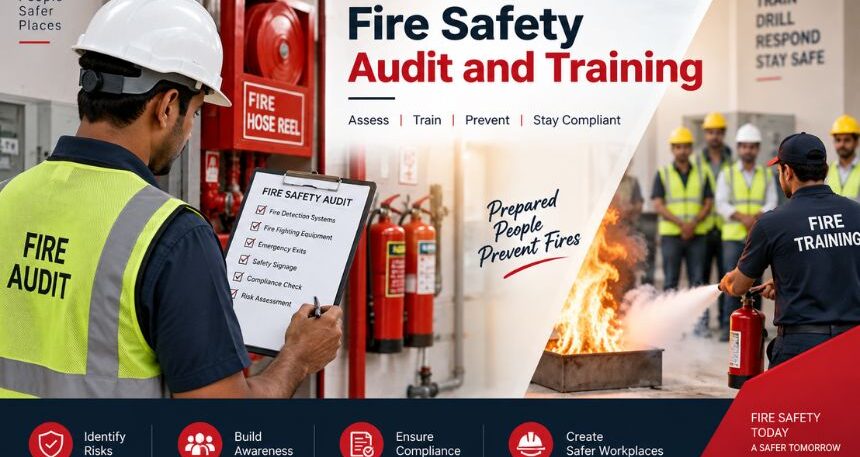
Fire Safety Audit and Training can transform fire safety from a compliance chore into a strategic risk-control program. This guide explains what a comprehensive audit covers, how it connects to role-based training, and how to choose the right partner so Indian facilities can reduce fire risk, support compliance, and keep people safer.
A fire safety audit is a structured review of how well a facility prevents, detects, controls, and responds to fire. It should examine people, procedures, documentation, and equipment together, not just hardware. A typical audit covers ignition sources, fuel loads, fire protection systems, means of escape, maintenance records, and emergency preparedness. Medium- and high-risk occupancies such as factories, warehouses, high-rise buildings, hospitals, malls, and data centers can benefit from periodic audits based on applicable regulations, risk levels, and operational requirements. When paired with Fire Safety Audit and Training, an audit can turn findings into practical behavior change through drills and role-based instruction.
Fire safety can look like a statutory checkbox, yet every serious incident can bring downtime, legal exposure, human loss, and insurance scrutiny. This guide reframes audits and training as core risk controls for Indian facilities. It explains what a fire safety audit is, why fire safety audits are important for industry, who should undertake a fire and life safety audit, how the audit process works, and how to choose a partner that understands Indian codes and real-world operations.
Seaara Universal Private Limited is a fire and safety company in India that supports industries with audit programs, training for engineers and wardens, and fire protection system maintenance that help keep sites inspection ready. The following sections walk through the concepts step by step so decision-makers can benchmark their current approach and plan the next improvement to their fire risk management program.
Key Takeaways
A short set of key points helps busy safety and facility leaders quickly understand why structured fire programs matter. These takeaways summarize how integrated fire auditing and training can protect people, assets, and operational continuity in Indian conditions.
● Fire safety audits are strategic risk controls, not just compliance tasks. They help organizations identify weaknesses in prevention, protection, emergency response, and human readiness, while supporting a targeted improvement plan.
● Strong audits look beyond extinguisher tags to systems, layouts, documentation, and drills. Fire and life safety performance depends on both equipment and people, so integrated auditing and training helps connect these elements.
● Focused, role-based training that reflects shifts and workplace hazards can improve emergency preparedness more effectively than generic lectures. When evaluating service partners, organizations should consider credentials, industry experience, methodology, and post-audit support.
Table of Contents
● What Is a Fire Safety Audit and Training and Why Does It Matter Beyond Compliance?
● Defining Fire and Life Safety Audit in the Indian Context
● Strategic Objectives of Fire Auditing and Training Services
● Why Fire Safety Audit and Training Are Critical for Industry in India
● Hidden Costs and Consequences of Fire Incidents
● Core Risk-Reduction Objectives of a Fire Safety Audit
● What Are the Key Components of a Comprehensive Fire Safety Audit and Training?
● Fire Risk Assessment, Systems, and Structural Safety
● Documentation, Procedures, and Human Readiness
● How Does the Fire Audit Process Work Step by Step?
● From Pre-Audit Planning to On-Site Inspection
● Risk Rating, Corrective Action Plan, and Re-Evaluation
● Who Should Undertake a Fire and Life Safety Audit in India?
● Sector-Specific Needs: Industry, High-Rise, Healthcare, and Retail
● Why Targeted Fire Safety Training Is as Important as the Audit
● From Generic Awareness to Role-Based Fire Warden Training
● Practical Drills, Extinguisher Use, and Safety Culture
● What Are the Business Benefits and Cost Considerations of Fire Safety Audit and Training?
● Safety, Compliance, and Business Continuity Benefits
● Cost Drivers and How to View Fire Audits as an Investment
● How to Choose the Right Fire Auditing and Training Partner in India
● Credentials, Experience, and Avoiding One-Size-Fits-All Solutions
● Basic Checklist-Based Approach vs. Specialist Fire Safety Partner
● Illustrative Client Scenario with Seaara Universal
● What Is Included in a Typical Fire Safety Audit Report?
● How Often Should Industrial Facilities in India Conduct a Fire Safety Audit?
● What Is the Difference Between Fire Risk Assessment and Fire Safety Audit?
● Who Should Receive Fire Warden Training in a Commercial Building?
● How Can We Ensure Our Fire Training Remains Effective Over Time?
● What Does A Fire Safety Audit Include And Who Needs One?
● How Can Fire Training And Audits Work Together To Reduce Risk?
What Is a Fire Safety Audit and Training and Why Does It Matter Beyond Compliance?
A fire safety audit for an Indian facility is a systematic assessment of fire and life safety performance across prevention, protection, emergency response, and management controls. It examines how actual workplace conditions compare with applicable provisions of the National Building Code of India, relevant Indian Standards, state or local fire safety requirements, and other regulations applicable to the facility. It also considers how well workers are prepared to respond.
When fire auditing and training are planned together, they show whether existing systems match real hazards and help turn those findings into training, drills, and maintenance actions. This combination supports business continuity, protects people in and around the facility, and provides management with documented evidence that fire risk is being actively managed.
Defining Fire and Life Safety Audit in the Indian Context
Inconsistent enforcement and documentation gaps can undermine even well-designed fire safety programs. A fire safety audit in India therefore focuses on how effectively a building and its operations control the likelihood and consequences of fire. A broader fire and life safety audit also considers evacuation, occupant protection, emergency response, and other life-safety measures. A fire risk assessment focuses more specifically on hazards, likelihood, severity, and control measures within particular processes, storage areas, or utilities.
Together, these activities may review:
● Layout, occupancy, and process hazards
● Fire detection and suppression systems
● Emergency lighting and exit signage
● Structural and passive fire protection
● Documentation such as fire NOCs, drill records, and maintenance logs
Well-structured audits that consider the National Building Code of India, applicable Indian Standards, state or local fire service requirements, and sector-specific guidelines can help demonstrate due diligence to regulators, insurers, customers, and corporate leadership.
Strategic Objectives of Fire Auditing and Training Services
Fire Safety Audit and Training should reveal patterns, not just isolated defects. They can highlight weak housekeeping, aging equipment, blocked exits, inadequate procedures, or training gaps that could allow a small ignition to develop into a serious event.
Workplace fire safety training then translates those findings into simple, practiced behaviours for operators, wardens, contractors, and other relevant personnel.
Well-governed programs can also support management oversight, customer requirements, ESG reporting, and worker-safety expectations within supply chains. When audits, training, fire manpower, and maintenance are coordinated under an integrated approach, organizations can maintain a more consistent standard of readiness across multiple sites and over time.
Why Fire Safety Audit and Training Are Critical for Industry in India
Fire safety audits matter for Indian industry because incidents rarely stop at damaged property. They can trigger production loss, worker harm, supply-chain disruption, community impact, and lengthy investigations.
A major fire in a plant, warehouse, or commercial complex can expose weaknesses in storage practices, escape routes, maintenance, supervision, emergency procedures, or fire protection systems.
Regular, structured fire and life safety audits help test whether controls that look effective on paper also work under real conditions such as shift changes, contract labour, peak production, and changing processes. For refineries, chemical plants, logistics hubs, manufacturing facilities, and high-rise campuses, audits can help identify combinations of hazards and control weaknesses before they contribute to a serious incident.
They also give management a clearer picture of risk and improvement actions when dealing with regulators, insurers, customers, and internal leadership.
Hidden Costs and Consequences of Fire Incidents
Major fire incidents can disrupt production schedules, delay shipments, damage equipment, and create contractual or supply-chain consequences. Injuries or fatalities can result in compensation claims, regulatory action, and potential civil or criminal liability depending on the circumstances and applicable law.
Insurance investigations may also examine issues such as housekeeping, maintenance, compliance, and the condition of fire protection systems. Poor documentation or unresolved deficiencies can complicate the review of a claim or renewal.
Reputational impact can be harder to repair, particularly when global customers conduct their own fire and life safety assessments or reconsider supplier relationships after a major incident.
Core Risk-Reduction Objectives of a Fire Safety Audit
A structured fire safety audit should:
● Map ignition sources, combustible loads, special process hazards, and high-occupancy zones.
● Check that detection, alarm, and suppression systems are appropriately designed, installed, tested, and maintained in accordance with applicable standards and approvals.
● Verify safe egress, emergency evacuation performance, and the practical effectiveness of fire warden teams.
● Identify gaps in procedures, documentation, training, and emergency preparedness.
● End with a clear corrective action plan with priorities, responsible owners, target dates, and follow-up checks.
What Are the Key Components of a Comprehensive Fire Safety Audit and Training?
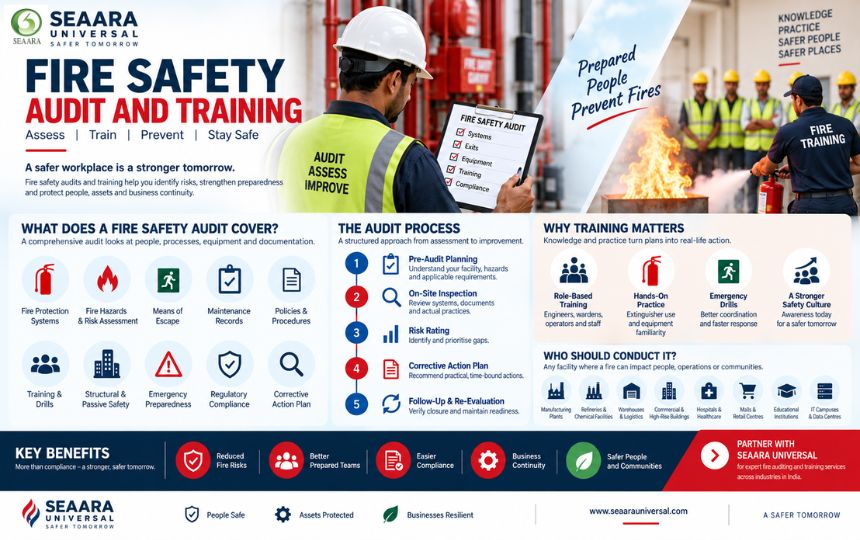
A thorough fire safety audit for Indian industrial and commercial facilities combines technical checks on equipment and structures with management-system review and worker interviews. It covers fire risk assessment, the condition and coverage of detection and suppression systems, structural and passive safety features, and the way procedures and training actually work in day-to-day operations.
Well-designed Fire Safety Audit and Training should therefore treat documentation, training records, and near-miss information as important parts of the overall assessment, alongside hydrants, sprinklers, alarms, and extinguishers. Fire incidents can result from combinations of technical, procedural, and human factors.
The output should provide a practical view of how these components interact, where protection may be inadequate or poorly maintained, and which improvements should be prioritized.
Fire Risk Assessment, Systems, and Structural Safety
The physical part of a fire safety audit starts with hazard identification and risk assessment across processes, utilities, and storage. Auditors look at flammable liquids and gases, gas cutting and welding activities, paint shops, boiler houses, electrical rooms, and battery charging areas to see how ignition sources are controlled.
They also examine housekeeping standards, segregation of hazardous materials, hot-work permits, and electrical safety practices such as load distribution, equipment condition, and cable routing.
Next comes a detailed review of fire protection. Fire extinguisher inspection should confirm appropriate extinguisher selection for expected fire hazards, adequate coverage, accessibility, mounting where applicable, and inspection or service records.
Fire detection and alarm systems are checked for panel condition, detector suitability and placement, alarm audibility and visibility, and relevant interfaces with public-address or building-management systems.
Active systems such as sprinklers, hydrants, standpipes, hose reels, clean-agent systems, foam systems, aerosol systems, and water-mist systems may be reviewed according to the hazards and systems installed at the facility. Checks can include design suitability, system condition, pressures where applicable, testing, and maintenance records.
Passive protection includes fire-rated doors, compartmentation between critical areas, sealing of shaft and cable penetrations, and assessment of structural fire-resistance provisions where applicable.
Documentation, Procedures, and Human Readiness
On the management side, auditors review whether there is a clear fire safety policy, defined roles such as fire officer and wardens, and an organization structure showing responsibilities.
They check maintenance and testing records for pumps, alarms, sprinklers, extinguishers, emergency lighting, and other systems against applicable Indian Standards, TAC guidance, OISD requirements, or other relevant sector-specific requirements.
Written emergency response plans, evacuation routes, assembly areas, and headcount procedures should be current and communicated to staff and contractors.
Training matrices and records should demonstrate workplace fire safety training, fire warden training, and periodic emergency evacuation drills for relevant personnel and shifts. Incident and near-miss reporting, along with evidence that lessons are incorporated into corrective actions, shows whether the system continues to improve over time.
How Does the Fire Audit Process Work Step by Step?
For Fire Safety Audit and Training to deliver meaningful risk reduction, the audit process needs a clear sequence from planning to verification.
A typical Indian engagement starts with pre-audit data collection, moves through detailed site inspection and interviews, and ends with a prioritized corrective action plan and an agreed schedule for follow-up.
Auditors should explain the assessment criteria and expected outputs before starting field work. When the provider also delivers training and maintenance support, the process can feed directly into drills, refresher programs, and maintenance planning so improvements are sustained beyond the initial report.
From Pre-Audit Planning to On-Site Inspection
Before arriving on site, the audit team conducts a briefing to understand the occupancy, processes, hazardous materials, utilities, and history of fires or near-misses. Depending on the scope, they may request architectural and fire-system drawings, layout plans, applicable fire NOCs, statutory approvals, maintenance records, and other relevant documentation.
This stage allows both sides to agree on the scope, plant areas to be covered, and documents required.
On-site work starts with walkthroughs of high-risk zones such as process blocks, warehouses, electrical rooms, basements, and high-rise escape routes.
Auditors compare actual conditions with drawings and written procedures, checking how hot work, isolation, maintenance, housekeeping, and emergency arrangements operate in practice. They may speak with operations, engineering, security, and other personnel across shifts to understand practices that could differ from formal procedures.
Life-threatening nonconformities such as locked exits, unavailable fire protection systems, or disabled alarms should be escalated promptly so appropriate interim controls can be considered before the final report.
Risk Rating, Corrective Action Plan, and Re-Evaluation
After the field visit, findings are consolidated into a structured risk-rating system, an approach reflected in established frameworks like the CFOA fire safety audit form used to standardize inspection scoring and follow-up actions, so management can focus attention on the most serious issues first.
Items that could directly threaten life safety or prevent evacuation should receive the highest priority, followed by other significant and lower-priority gaps that need planned closure. The precise rating methodology can be tailored to the facility, audit scope, applicable requirements, and the service provider’s assessment framework.
The corrective action plan for fire safety should describe each gap in plain language, recommend a practical measure, identify a responsible owner, and set a realistic target date. Where appropriate, it can also include budget estimates.
Actions might range from housekeeping, signage, and procedural changes to capital projects such as hydrant upgrades, fire detection improvements, or compartmentation work.
Recommended re-audit frequency depends on risk level, change rate, regulatory expectations, and the nature of the facility. High-hazard operations may require more frequent assessments, while additional audits can be appropriate after significant process changes, expansions, incidents, or regulatory directions.
Providers can support re-evaluation through periodic inspections and annual maintenance contracts so systems and procedures remain ready between full audits.
Fire Safety Audit and Training Services
Who Should Undertake a Fire and Life Safety Audit in India?
Any Indian facility where a fire could seriously harm people, disrupt business, or affect nearby communities should consider regular fire and life safety audits. This includes:
● Manufacturing plants
● Refineries and chemical facilities
● Warehouses and logistics parks
● High-rise commercial and residential buildings
● Hospitals and healthcare facilities
● Malls and retail centres
● Educational institutions
● IT campuses and data centres
● Government and institutional buildings
The frequency and scope should reflect the facility’s hazards, occupancy, applicable regulations, operational changes, and internal risk-management requirements.
Global buyers and investors may also expect suppliers and partners to maintain credible fire risk assessments, audit reports, training records, and corrective-action evidence for core production and support facilities.
For owners and occupiers, commissioning Fire Safety Audit and Training can therefore support more than local compliance. It can contribute to board oversight, customer assurance, worker safety, and long-term business resilience.
Sector-Specific Needs: Industry, High-Rise, Healthcare, and Retail
Industrial plants and refineries deal with flammable liquids, gases, high temperatures, and pressurized systems. Audits therefore need to consider applicable OISD guidelines, Indian Standards, statutory requirements, and sector-specific practices. These facilities may require trained in-house fire teams, dedicated fire-water networks, fixed foam systems, emergency shutdown procedures, and specialized response arrangements.
Warehouses and logistics hubs can face high fuel loads and tall storage racks. Auditors therefore pay particular attention to sprinkler arrangements, storage configuration, aisle widths, smoke management, detection, and the ability of staff to evacuate areas deep inside storage facilities.
High-rise commercial and residential towers require particular attention to stairwell protection and pressurization where provided, refuge areas or floors where applicable, lift behaviour under fire conditions, fire doors, escape routes, and large occupant loads.
Hospitals and healthcare buildings must account for patients with limited mobility and the continued operation of critical services. Audits can therefore place greater emphasis on compartmentation, smoke management, evacuation planning, staff roles, and arrangements for patients who cannot self-evacuate.
Malls, multiplexes, and retail centres need crowd-management strategies, tenant fit-out compliance, reliable public-address systems, clear escape routes, and coordination between tenants, security teams, facility management, and emergency services.
Government and institutional buildings combine public access, critical records, and varied occupancies. They benefit from documented fire risk assessments and periodic review of emergency preparedness.
Why Targeted Fire Safety Training Is as Important as the Audit
Even the best audit report achieves little if people do not know how to act when alarms sound or smoke appears.
Targeted fire safety training works with audit findings to build specific skills for operators, wardens, security staff, engineers, and other relevant personnel. The aim is to help them prevent escalation, initiate appropriate responses, and support safe evacuation.
Fire Safety Audit and Training that treat learning as a practical exercise rather than a check-the-box classroom session can help organizations build stronger emergency preparedness.
Training should also be refreshed when engineering upgrades, process changes, audit findings, incidents, or workforce changes alter the facility’s risk profile.
From Generic Awareness to Role-Based Fire Warden Training
Generic safety lectures that repeat the same slides for every audience may not adequately prepare people for their specific responsibilities during a high-stress emergency.
A more effective program begins with concise employee orientation covering alarm signals, evacuation routes, assembly areas, emergency reporting, and basic fire-prevention responsibilities.
Fire warden and floor marshal training can go deeper into:
● Conducting area sweeps, including washrooms and less-visible areas
● Helping vulnerable occupants where appropriate
● Guiding people toward designated assembly points
● Reporting evacuation status to the control room or incident controller
● Identifying and reporting hazards
● Supporting orderly evacuation without putting themselves at unnecessary risk
Engineers and maintenance staff may require technical instruction on operating fire pumps, valves, hydrant panels, gas-suppression control panels, pressurization fans, and other systems installed at the facility, including responses to common fault conditions.
When a provider also supplies trained fire personnel on site, those personnel can support wardens, assist with drills, and help keep emergency arrangements and fire protection systems operational.
Practical Drills, Extinguisher Use, and Safety Culture
Hands-on extinguisher practice using the PASS method can help selected personnel understand extinguisher selection, safe approach principles, operation, and when to withdraw rather than attempt firefighting.
Regular emergency evacuation drills across relevant shifts can provide management with useful information about evacuation times, bottlenecks, communication gaps, and the effectiveness of assigned roles.
Short debriefs after drills or near-miss incidents support learning by connecting everyday observations with the formal emergency plan.
Over time, recurring training and documented improvement processes can help establish a safety culture in which employees treat fire precautions as part of normal work rather than an additional administrative task.
Tip Treat every drill as a live test of your procedures, not a formality. Capture what went well, what failed, and update the relevant plan or corrective actions within a defined timeframe.
What Are the Business Benefits and Cost Considerations of Fire Safety Audit and Training?
Fire Safety Audit and Training can deliver business value by helping organizations identify fire hazards, strengthen controls, improve emergency preparedness, and reduce the potential severity of incidents.
An effective program can protect people and assets, support operational continuity, and provide documented evidence of risk-management activities to regulators, customers, insurers, and management.
At the same time, leaders need to understand what drives the cost of fire audit services and training so they can budget realistically and view the spend as risk management rather than simply overhead.
When audits, training, and maintenance are planned together, organizations may also gain efficiencies from coordinated scheduling and follow-up.
Safety, Compliance, and Business Continuity Benefits
Well-planned audits and follow-up training can help address routine issues such as blocked exits, poorly maintained equipment, inadequate housekeeping, or unattended hot work before they contribute to a serious event.
When an incident does occur, effective detection, suppression, evacuation, and emergency response arrangements can help limit its consequences.
Compliance with applicable fire services, development authorities, labour requirements, and other regulations becomes easier to demonstrate when organizations maintain current audit reports, risk assessments, maintenance records, and documented emergency drills.
For insurance reviews, inspection and testing records, fire risk assessments, and evidence of emergency preparedness can provide useful documentation of risk-management practices. Insurance outcomes, however, depend on the individual policy, insurer, facility, and circumstances.
From a continuity perspective, clear procedures, emergency roles, alternative arrangements, and rehearsed responses can help organizations manage disruption more effectively after an incident.
Cost Drivers and How to View Fire Audits as an Investment
The cost of fire audit services depends largely on:
● Facility size and layout complexity
● Number of buildings and occupancy types
● Presence of special hazards such as flammable-gas areas or solvent stores
● Depth of engineering checks required
● Number and duration of drills and training sessions
● Number of locations to be covered
● Availability and quality of existing documentation
Engagements that include detailed engineering checks, multi-day emergency drills, or coverage across several locations naturally require more auditor time and expertise.
Combining audits with maintenance contracts and scheduled training can sometimes provide better overall value than purchasing each activity separately.
When comparing proposals, decision-makers should look beyond the lowest fee and examine scope clarity, auditor qualifications, methodology, deliverables, and willingness to support post-audit review.
Viewing the spend as an investment becomes easier when audit and training costs are considered alongside the potential consequences of production interruption, equipment damage, regulatory action, human harm, and customer disruption.
How to Choose the Right Fire Auditing and Training Partner in India
Choosing a partner for Fire Auditing and Training Services in India requires attention to technical competence, sector experience, and the ability to support long-term improvement rather than provide only a one-time inspection.
Providers should demonstrate an understanding of Indian codes, local authority requirements, and industry-specific guidelines, along with a practical approach that fits the organization’s operations and workforce.
Seaara Universal Private Limited combines ISO 9001–aligned quality processes with field experience across refineries, manufacturing plants, hospitals, malls, and IT parks, and delivers audits, training, manpower, and system commissioning under a single umbrella.
This integrated approach can help organizations maintain consistent fire safety practices as they expand, modify processes, or upgrade their protection systems.
Credentials, Experience, and Avoiding One-Size-Fits-All Solutions
A capable partner should operate within an appropriate quality-management framework and apply relevant Indian Standards, TAC recommendations, OISD guidelines, and local requirements wherever applicable.
Audit personnel should have appropriate fire safety knowledge, practical industry experience, and an understanding of the hazards associated with the facilities they assess, with competence benchmarked against frameworks like the Level 4 fire auditor qualification used to formally certify fire safety auditing professionals.
Before appointing a firm, ask for examples of work in sectors such as oil and gas, pharmaceuticals, heavy engineering, IT campuses, hospitals, and educational institutions that resemble your own risks.
Beware of providers who rely only on generic checklists or off-the-shelf training presentations that ignore specific processes, utilities, hazards, and occupancy patterns.
High-value providers spend time understanding hazards, layouts, existing systems, and operational practices before recommending changes or courses.
Organizations may also benefit from selecting partners that can commission new systems, provide trained fire manpower, and maintain equipment over time, since coordinated services can reduce handoffs and clarify accountability.
Basic Checklist-Based Approach vs. Specialist Fire Safety Partner
| Aspect | Basic Checklist-Based Approach | Specialist Fire Safety Partner |
| Approach to scope | Same checklist for every facility | Scope tuned to industry, hazards, occupancy, and applicable requirements |
| View on training | One generic session for all roles | Role-based, practical training and drills |
| Support after audit | Report only, with limited follow-up | Closure tracking, support, and re-audits |
| Integration with maintenance | Separate contractors with weak coordination | Linked maintenance, audit, and training planning |
Illustrative Client Scenario with Seaara Universal
Consider a mid-sized automotive component plant that has experienced several minor electrical fires and growing concern from its insurer. Management commissions a fire and life safety audit along with a hazard identification review for storage and painting operations.
The resulting corrective action plan includes improvements to hydrant network zoning, extinguisher placement, cable management, and housekeeping controls.
Targeted training for engineers, structured fire warden training, and periodic emergency evacuation drills then help staff become familiar with the revised procedures.
In this illustrative scenario, subsequent audit cycles show improved preparedness, smoother external inspections, and greater management confidence in the facility’s fire safety arrangements.
To Sum Up
Fire Safety Audit and Training sit at the centre of modern fire risk management for Indian industrial, commercial, and institutional facilities.
A well-run program links technical audits, engineering improvements, drills, and training so that prevention, protection, and people readiness move in the same direction.
This approach can help protect workers, visitors, communities, and assets while supporting compliance with applicable fire and safety requirements.
When organizations treat fire safety audits as regular, expert health checks on their operations, they can identify improvement opportunities before deficiencies contribute to a serious incident or are highlighted by regulators, insurers, or customers.
Seaara Universal Private Limited offers integrated audits, training, manpower, and fire protection system support, giving decision-makers a single partner for long-term readiness.
To discuss your current fire and life safety posture, schedule a fire safety audit, or plan focused training for your teams, contact Seaara Universal today and start building a stronger fire safety roadmap for your facilities. To learn more about how our Fire Safety Audit and Training apply to your specific industry, reach out to our team and get started on your next audit cycle.
Frequently Asked Questions
What Is Included in a Typical Fire Safety Audit Report?
A typical fire safety audit report includes an executive summary with the overall risk rating and key issues, detailed observations covering prevention, protection, egress, documentation, and training, and supporting photographs where appropriate.
It should also identify the applicable codes, standards, regulations, or guidelines considered during the audit and present a prioritized corrective action plan with responsibilities and target dates.
How Often Should Industrial Facilities in India Conduct a Fire Safety Audit?
The appropriate frequency depends on the facility’s hazards, occupancy, applicable regulatory requirements, operational changes, and risk profile.
Many high-risk industrial facilities benefit from periodic comprehensive audits, often annually, while interim inspections and maintenance activities help maintain readiness between full audits.
Additional audits may be appropriate after significant process changes, expansions, serious incidents, or specific regulatory directions.
What Is the Difference Between Fire Risk Assessment and Fire Safety Audit?
A fire risk assessment focuses on identifying hazards, evaluating likelihood and severity, and deciding risk-control measures for particular areas, processes, or activities.
A fire safety audit takes a broader view of systems, structures, management practices, emergency arrangements, documentation, and training across the facility.
Many organizations use both approaches together so detailed risk findings can feed into the wider audit and improvement plan.
Who Should Receive Fire Warden Training in a Commercial Building?
Fire warden training should cover responsible representatives for relevant floors, zones, or departments, including tenant coordinators, security staff, and key operations supervisors where appropriate.
Organizations should maintain sufficient coverage for their occupancy and shift patterns.
Competencies can include area sweeps, assisting vulnerable persons, guiding occupants to assembly points, identifying hazards, and communicating status to the incident controller.
How Can We Ensure Our Fire Training Remains Effective Over Time?
Fire safety training remains effective when organizations maintain a structured training and drill calendar, refresh training for high-turnover roles and contractors, and update content after audits, incidents, process changes, or system upgrades.
Periodic drills and documented debriefs help identify gaps between written procedures and actual behaviour.
External support from qualified specialists can also help organizations evaluate drill performance and keep their fire safety training aligned with changing hazards, applicable requirements, and organizational needs.
What Does A Fire Safety Audit Include And Who Needs One?
A fire safety audit includes a review of ignition sources, fuel loads, fire detection and suppression systems, escape routes, structural fire protection, maintenance records, emergency procedures, and the level of fire safety training. It checks how these elements work together so the facility can prevent fires, limit their growth, and evacuate occupants safely.
Industries with higher fire loads, high-rise buildings, hospitals, malls, warehouses, data centres, and public buildings in India all need periodic fire safety audits. Any organization where a fire could cause serious harm to people, damage critical assets, or disrupt operations should schedule audits at defined intervals.
How Can Fire Training And Audits Work Together To Reduce Risk?
Fire safety audits identify gaps in equipment, procedures, and human readiness, while fire training focuses on how people should prevent incidents and respond during an emergency. When the same partner manages both activities, training content can directly reflect current hazards, recent findings, and installed systems.
This link between audit findings and role-based training helps close gaps faster, builds confidence in emergency plans, and keeps the facility’s fire risk controls aligned with day-to-day operations.