

Fire protection requirements can vary significantly between a large industrial facility and a small electrical enclosure. A conventional fire suppression system may require cylinders, pipework, nozzles and considerable installation space, while some equipment requires protection inside a compact, enclosed area where water-based suppression may not be appropriate.
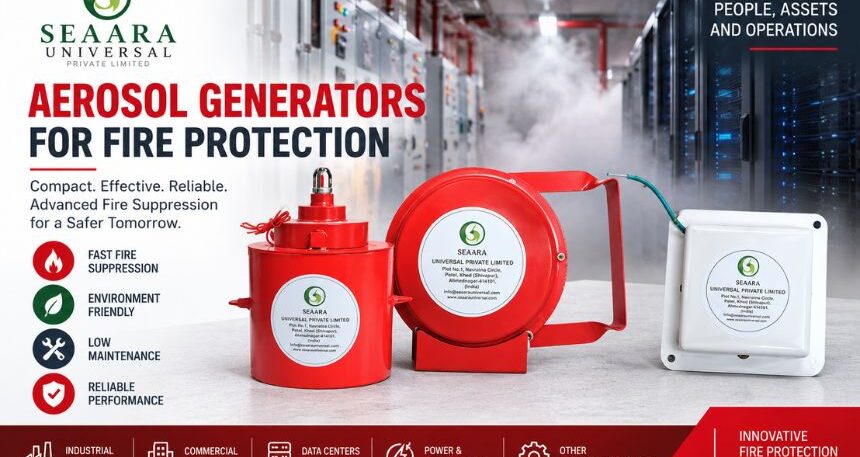
Aerosol generators for fire protection provide an alternative approach for many such applications. These compact devices generate a condensed aerosol agent that can rapidly disperse through a protected enclosure and suppress combustion. Depending on the system design, aerosol generators can be used for electrical panels, switchgear, server rooms, generator rooms, transformers, industrial machinery and other enclosed hazards.
Seaara Universal Private Limited offers the SAG range of aerosol suppression generators in different capacities for different protected volumes and applications. This guide explains what aerosol generators are, how they work, the different configurations available, where they can be used and how to approach generator selection. Industry standards such as NFPA 2010 outline the general approach to condensed aerosol fire extinguishing systems, while NFPA 70 and IEC 60364 provide context for electrical installation safety.
For a broader explanation of aerosol fire suppression technology, its working principle, advantages, limitations and system design considerations, read more at Seaara Universal Private Limited’s Aerosol Fire Suppression System in great detail.
Key Takeaways
Aerosol generators for fire protection use solid aerosol-forming compounds to protect enclosed electrical, electronic and industrial hazards where conventional water-based systems may not suit the risk.
The Seaara SAG range covers capacities from 30 g for 1 m³ enclosures up to 7 kg for 140 m³ enclosures, so generator selection must match the actual hazard and net volume.
Effective protection depends on enclosure integrity, ventilation control, the correct activation method and application-specific engineering, not on room volume alone.
Aerosol generators can reduce infrastructure space compared with cylinder and pipework systems, but they leave particulate residue that requires planned cleanup after discharge.
Seaara Universal Private Limited supports projects with application engineering, integration with detection and control, commissioning and documentation for aerosol-based fire suppression.
Aerosol Generators for Fire Protection
Table of Contents
- Aerosol Generators for Fire Protection
- What is an aerosol generator for fire protection
- How aerosol generators work
- Types of aerosol generators
- Seaara SAG aerosol generators for fire protection
- Aerosol generators for electrical panel fire protection
- Aerosol generators for switchgear and MCCs
- Aerosol generators for server rooms and IT equipment
- Aerosol generators for generator and DG rooms
- Aerosol generators for transformer protection
- Aerosol generators for industrial machinery
- How to choose the right aerosol generator
- Aerosol generator and aerosol fire suppression system
- Advantages of aerosol generators for fire protection
- Limitations and design considerations
- Aerosol generator installation considerations
- Maintenance and post-discharge requirements
- Why generator selection should be application specific
- Seaara Universal aerosol generators for fire protection
- Frequently asked questions about aerosol generators
- Summary on aerosol generators for fire protection
What is an aerosol generator for fire protection
An aerosol generator is the primary agent-generating device used in a condensed aerosol fire suppression system. Instead of storing a conventional gaseous extinguishing agent in a large pressurized cylinder, an aerosol generator contains a solid aerosol-forming compound that produces a fine aerosol when activated.
The resulting aerosol consists of very fine particles carried by gases. Once released into a suitably enclosed protected space, the aerosol disperses around the hazard and acts on the combustion process to suppress the fire.
A complete aerosol fire suppression system can contain considerably more than the generator itself. Depending on the application, it may include 1 or more of the following elements.
· Aerosol generator or generators
· Smoke, heat or flame detection
· Fire suppression control panel
· Electrical release circuits
· Thermal activation elements
· Manual release facilities
· Alarm and warning devices
· Abort or delay arrangements where required
· Power supply and battery backup
· HVAC and equipment shutdown interlocks
· Enclosure and ventilation controls
Therefore, an aerosol generator is a component of an aerosol fire suppression system, rather than being synonymous with the complete engineered system.
How aerosol generators work
A condensed aerosol generator uses a controlled reaction to convert a solid aerosol-forming compound into a fine aerosol containing solid particles and gases.
Condensed aerosol fire suppression systems generate fine solid particles and gaseous matter from a solid aerosol-forming compound. These particles help suppress combustion through chemical inhibition. NFPA 2010, Standard for Fixed Aerosol Fire-Extinguishing Systems, addresses the design, installation, operation, testing, and maintenance of fixed aerosol suppression systems. System selection and installation should follow the applicable standard, product listing and manufacturer instructions.
The basic operating sequence is:
· A fire is detected by the appropriate detection device or thermal activation arrangement.
· The activation circuit triggers the aerosol generator.
· The generator initiates a controlled reaction.
· Fine aerosol particles and gases are produced.
· The aerosol disperses throughout the protected enclosure.
· The particles interfere with the chemical chain reaction of combustion.
· The fire is suppressed when the required concentration and application conditions are achieved.
This is different from simply cooling a fire with water or suppressing it primarily through oxygen displacement.
Types of aerosol generators
Aerosol generators can be differentiated in several ways, including their agent capacity, physical configuration, activation method and intended application.
By capacity
Different generator sizes can be selected for different protected volumes. Smaller units are suitable for compact enclosures, while larger generators can be used as part of systems protecting larger enclosed spaces.
By activation method
The Seaara brochure identifies three activation methods.
· Electrically operated
· Manually operated
· Thermally operated
Electrical activation can be integrated with detection and a fire suppression control panel. Thermal activation can provide local automatic operation through heat-sensitive activation arrangements. Manual operation can be used where manual release is part of the system design.
By application
Aerosol generators can also be selected according to the hazard being protected, such as:
· MCCs
· Switchgear
· Control cabinets
· Data processing rooms
· Transformers
· Industrial machinery
· Battery rooms
· Other enclosed technical spaces
The correct configuration depends on the specific hazard and enclosure rather than simply selecting a generator based on room volume alone.
Seaara SAG aerosol generators for fire protection
Seaara Universal’s brochure presents a range of SAG Aerosol Suppression System generators with different capacities and stated area or volume coverage. The smallest listed unit, SAG 3-0.03, is rated at 30 g for 1 m³, while the largest, SAG 3-7, is rated at 7 kg for 140 m³, so the capacity varies by more than 200x across the family.
The range allows aerosol suppression to be considered for applications ranging from small electrical enclosures to substantially larger enclosed industrial spaces.
| Model | Capacity | Stated coverage | Starter type |
| SAG 3-0.03 | 30 g | 1 m³ | Electrical / Thermal |
| SAG 3-0.05 | 50 g | 1.6 m³ | Electrical / Thermal |
| SAG 3-0.3 | 300 g | 10 m³ | Electrical / Thermal |
| SAG 3-0.5 | 500 g | 17 m³ | Electrical / Thermal |
| SAG 3-1 | 1 kg | 20 m³ | Electrical / Thermal |
| SAG 3-2 | 2 kg | 40 m³ | Electrical / Thermal |
| SAG 3-3 | Not stated in supplied table | 60 m³ | Manual / Thermal |
| SAG 3-4 | 4 kg | 80 m³ | Electrical / Thermal |
| SAG 3-7 | 7 kg | 140 m³ | Electrical / Thermal |
Note: The coverage figures above are the values stated in the Seaara product brochure. Actual system sizing should not be determined from volume alone. Final selection should follow the applicable design methodology, manufacturer data and the characteristics of the protected hazard.
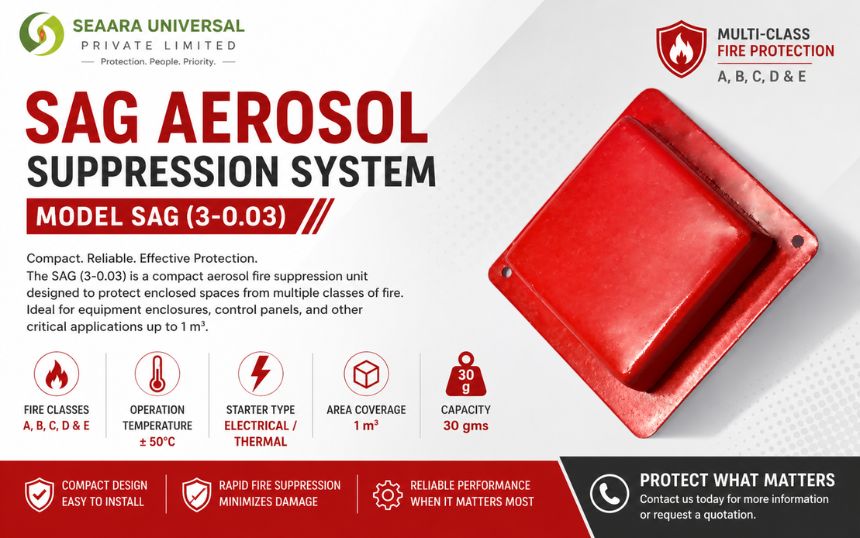
SAG 3-0.03
The SAG 3-0.03 is a compact aerosol suppression generator with a 30 g capacity, fire classes stated in the brochure as A, B, C, D & E, an operating temperature of ±50°C, Electrical / Thermal starter type and stated coverage of 1 m³. Its compact form makes this type of generator particularly relevant to small enclosed hazards such as electrical cabinets and control enclosures.
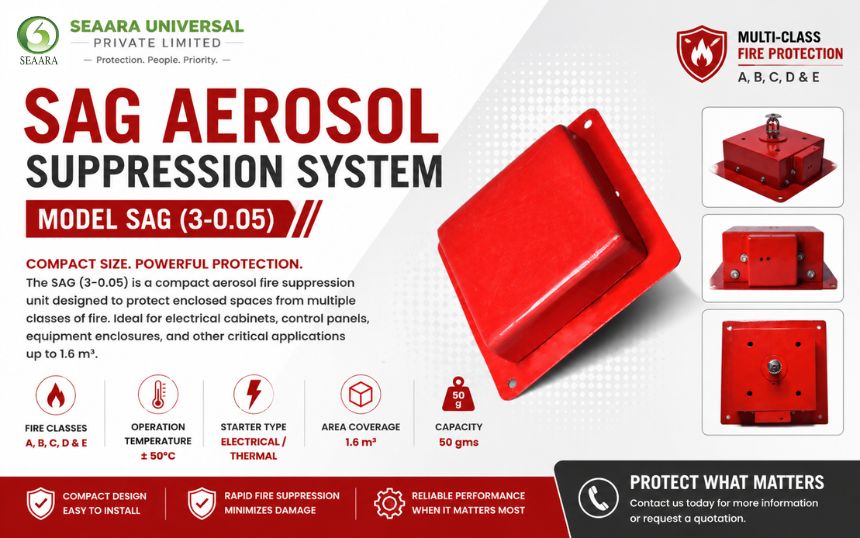
SAG 3-0.05
The SAG 3-0.05 provides a 50 g capacity, fire classes stated in the brochure as A, B, C, D & E, an operating temperature of ±50°C, Electrical / Thermal starter type and stated coverage of 1.6 m³. This unit provides a step up from the smallest 30 g unit, so the nominal coverage rises by about 60%.
SAG 3-0.3
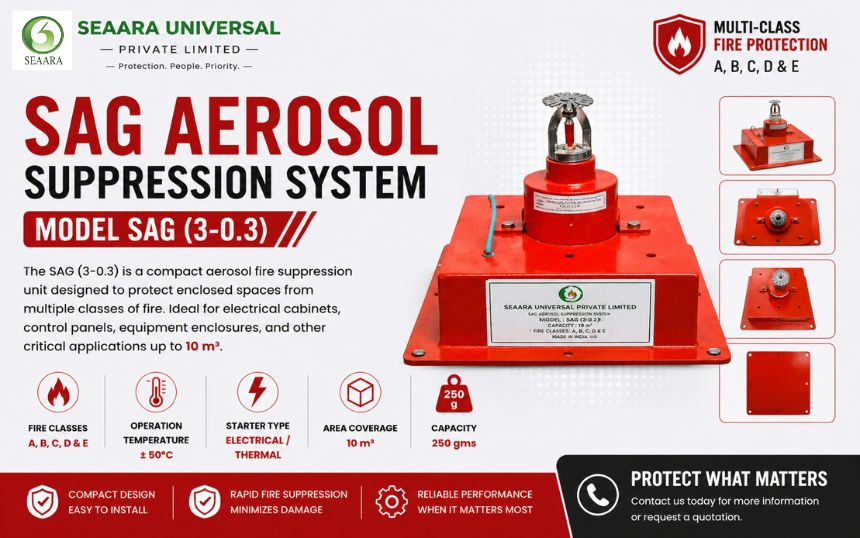
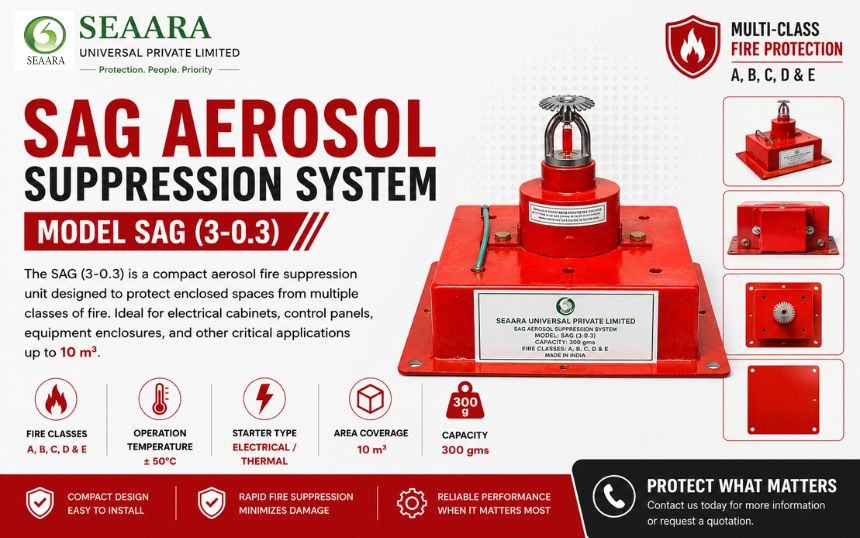
The SAG 3-0.3 has a 300 g capacity, fire classes stated in the brochure as A, B, C, D & E, an operating temperature of ±50°C, Electrical / Thermal starter type and stated coverage of 10 m³. Its larger capacity makes it suitable for applications requiring greater aerosol quantity than the compact 30 g and 50 g units, with more than 3x the stated volume coverage of SAG 3-0.05.
SAG 3-0.5
The SAG 3-0.5 provides a 500 g capacity, fire classes stated in the brochure as A, B, C, D & E, an operating temperature of ±50°C, Electrical / Thermal starter type and stated coverage of 17 m³. This generator can be considered for larger enclosed electrical or industrial applications where the required design quantity is greater, and the step from 10 m³ to 17 m³ represents a coverage increase of 70%.
SAG 3-1
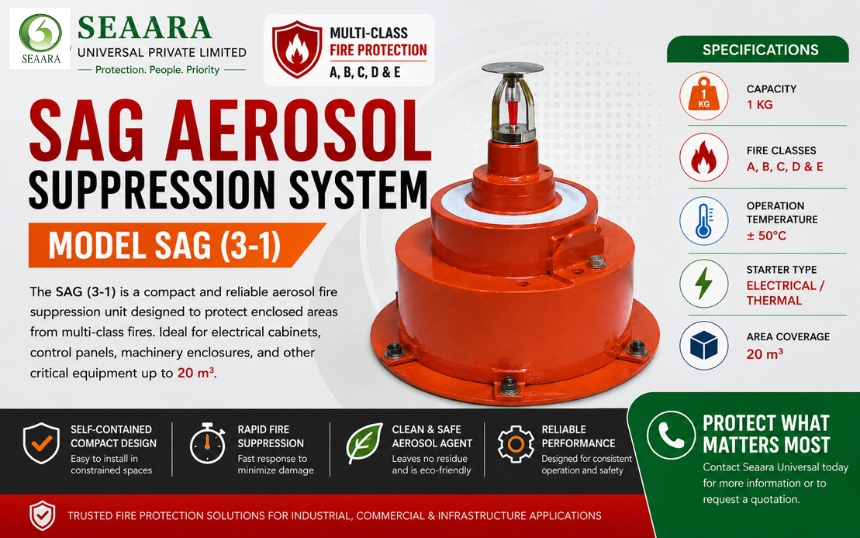
The SAG 3-1 is a 1 kg aerosol generator with fire classes stated in the brochure as A, B, C, D & E, an operating temperature of ±50°C, Electrical / Thermal starter type and stated coverage of 20 m³. The cylindrical generator format is designed for larger protected volumes compared with the compact SAG units, although the move from 500 g to 1 kg capacity produces a smaller percentage gain in listed coverage than the earlier jumps.
SAG 3-2
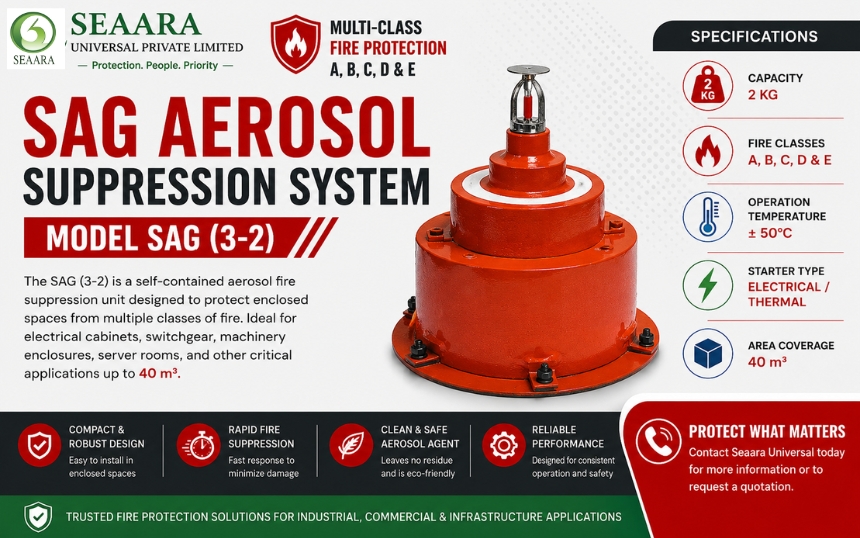
The SAG 3-2 provides a 2 kg capacity, fire classes stated in the brochure as A, B, C, D & E, an operating temperature of ±50°C, Electrical / Thermal starter type and stated coverage of 40 m³. This larger generator can form part of an aerosol fire suppression system designed for medium-sized enclosed spaces.
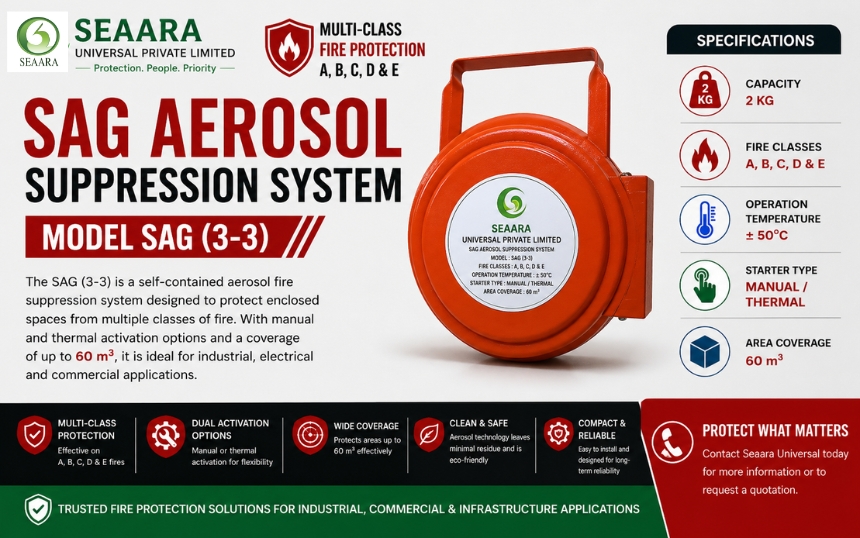
SAG 3-3
The SAG 3-3 has a different configuration from several other SAG generators and is listed with fire classes A, B, C, D & E, an operating temperature of ±50°C, Manual / Thermal starter type and stated coverage of 60 m³. Its manual or thermal activation configuration provides flexibility for applications where this type of activation is appropriate.
SAG 3-4
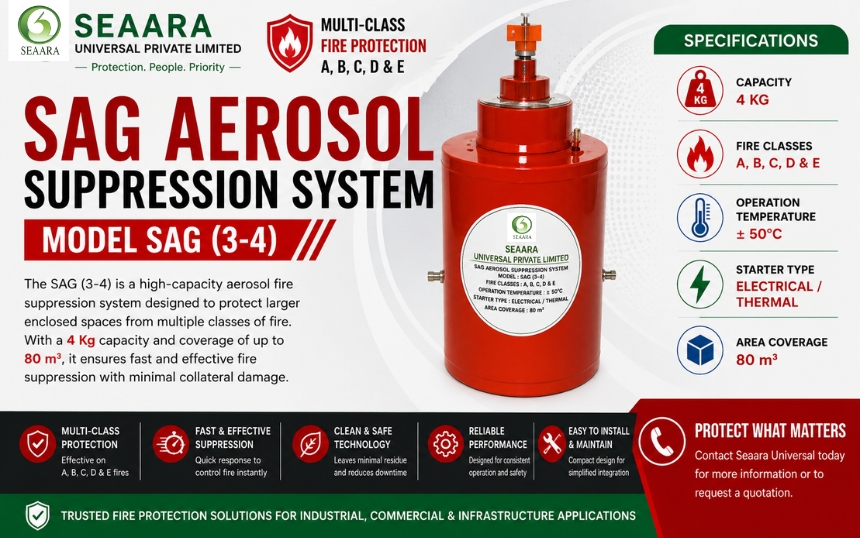
The SAG 3-4 provides a 4 kg capacity, fire classes stated in the brochure as A, B, C, D & E, an operating temperature of ±50°C, Electrical / Thermal starter type and stated coverage of 80 m³. This larger unit can be used where the protected enclosure requires a substantially greater aerosol quantity, 2x the stated volume of SAG 3-2.
SAG 3-7
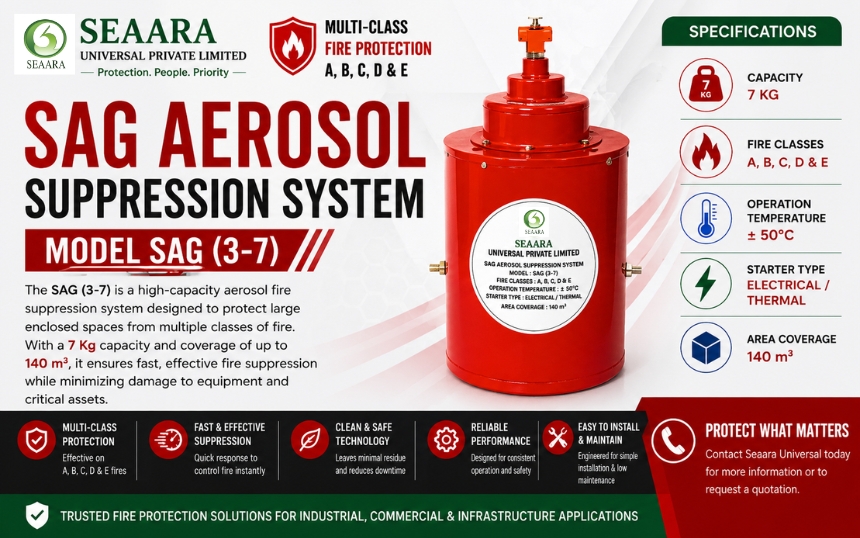
The SAG 3-7 is one of the largest generators shown in the Seaara brochure, with a 7 kg capacity, fire classes stated as A, B, C, D & E, an operating temperature of ±50°C, Electrical / Thermal starter type and stated coverage of 140 m³. It provides substantially larger stated coverage than the compact SAG models and can therefore be considered for larger enclosed industrial applications subject to appropriate system design.
Aerosol generators for electrical panel fire protection
Electrical panels are among the practical applications for compact aerosol generators. MCCs, LT panels, control cabinets, PLC cabinets, relay panels and switchgear contain electrical connections, insulation, cables and other components that can become involved in a fire following electrical faults, overheating or component failure.
Installing an appropriately designed aerosol generator within or adjacent to a protected enclosure can provide localized fire suppression without requiring a conventional network of water pipes and discharge nozzles inside the cabinet. For many cabinets, a single compact generator can protect the internal volume, while wider or taller panels may need 2 or more units to achieve the coverage required by the design method.
For small electrical enclosures, compact generators such as the SAG 3-0.03 and SAG 3-0.05 may be considered, while larger enclosures may require different generator capacities or multiple generators. The selection must be based on the actual enclosure and hazard characteristics rather than simply choosing the largest available generator.
Aerosol generators for switchgear and MCCs
Switchgear and MCC installations can contain multiple potential ignition sources and valuable electrical equipment. Aerosol generators can be incorporated into a broader fire protection strategy for LV switchgear, MV switchgear, MCC panels, control panels, relay panels and protection panels.
Depending on the installation, generators can operate independently through thermal activation or be integrated with an external fire detection and suppression control system. Where switchboards extend for several meters, the design may divide them into 2 or more protection zones so that the aerosol concentration can develop correctly in each section.
Aerosol generators for server rooms and IT equipment
Server rooms, telecom rooms and smaller data-processing environments can contain highly valuable electronic equipment in relatively confined spaces. Traditional water-based suppression may be undesirable around sensitive electronics, while conventional gaseous systems may require cylinders and distribution pipework.
Aerosol generators provide another technology that can be considered for suitable enclosed IT environments. However, residue should be taken into account during system selection. Aerosol systems produce fine solid particulate residue following discharge, so facilities with exceptionally stringent cleanliness requirements should evaluate whether the technology is appropriate.
Aerosol generators for generator and DG rooms
Diesel generator rooms and generator enclosures can contain several potential fire hazards, including fuel systems, hot engine surfaces, lubricating oils, electrical connections, cables and battery systems.
The relatively enclosed nature of many generator installations can make aerosol suppression worth considering as part of the fire protection strategy. Aerosol generators can be activated thermally or electrically depending on the design.
For larger generator rooms, the system should be engineered around the actual enclosure volume, ventilation characteristics and fuel hazards. It is common to calculate the net volume by subtracting engine blocks and tanks, then apply the required agent quantity per m³ according to the design method so that the final generator count and total kilograms of aerosol follow a repeatable calculation.
Aerosol generators for transformer protection
Transformers present an important application because of the electrical energy and, depending on transformer type, potentially combustible insulating materials or oil.
Seaara’s product range also includes a dedicated SAG 3-4-1 Transformer Protection model.
The brochure identifies the unit as:
· Model SAG 3-4-1
· Capacity 4 kg
· Operating temperature ±50°C
· Starter type Thermal
· Area coverage 80 m³
Transformer protection should always be engineered according to the actual transformer construction, enclosure, fuel or insulating medium, ventilation and applicable fire protection requirements.
Aerosol generators for industrial machinery
Industrial machinery can contain localized fire hazards that are difficult to protect with conventional room-level systems. Examples include CNC machines, EDM machines, machinery with oil-based coolants, enclosed processing equipment, electrical machinery compartments and machine control enclosures.
Aerosol generators can provide localized protection where the equipment is sufficiently enclosed to allow the aerosol concentration to develop. The Seaara brochure identifies machinery compartments and industrial applications among potential areas of use. For some equipment lines, a single enclosure can combine several hazard zones, so the final design may apply 2x or 3x cabinet-level generators to that one machine.
How to choose the right aerosol generator
Protected volume
The internal volume of the enclosure is an important starting point. Seaara’s SAG range includes generators with brochure-stated coverage from 1 m³ to 140 m³. However, net protected volume should be calculated appropriately rather than relying only on external room dimensions, and the agent quantity per m³ should follow the design criteria supplied for the chosen hazard class.
Type of fire hazard
The fuel involved should be identified. Examples include electrical insulation, cable materials, plastics, oils, machinery fluids and other combustible materials. The fire hazard determines whether aerosol suppression is appropriate and how the system should be designed.
Enclosure integrity
Aerosol suppression depends on achieving an appropriate concentration within the protected area. Large openings, continuous ventilation and uncontrolled air movement can reduce the concentration and affect system performance. Doors, louvers, cable penetrations, ventilation openings, HVAC systems, raised floors and other leakage paths should be evaluated.
Activation method
The appropriate activation method depends on the application. Electrical activation can be connected to a fire detection and suppression control system. Thermal activation can respond to elevated temperature at or around the protected hazard. Manual activation can be incorporated where the system design requires operator-initiated discharge.
Occupancy
Occupied spaces require additional consideration of detection, alarm, pre-discharge warning, evacuation, delay arrangements, ventilation and re-entry procedures. Aerosol systems should not be treated as a one-size-fits-all solution for every occupied environment.
Equipment sensitivity and residue
One of the important differences between aerosol and gaseous clean-agent systems is the presence of particulate residue after discharge. For electrical and industrial applications, the expected residue and cleanup requirements should be evaluated before selecting the technology.
Aerosol generator and aerosol fire suppression system
It is important to distinguish between these two terms.
Aerosol generator
The generator is the device that produces and releases the condensed aerosol agent.
Aerosol fire suppression system
The complete system can include detection, control, alarm, activation, aerosol generator or generators, discharge, equipment or HVAC interlocks and other system components. A multi-generator room protection system may contain several generators connected to a central control panel, while a cabinet-level system may use a compact generator with a thermal activation arrangement.
Advantages of aerosol generators for fire protection
Compact installation
Generators can occupy considerably less infrastructure space than systems based around large cylinder banks and extensive pipework. For example, a 7 kg generator with 140 m³ stated coverage avoids the need for multiple high-pressure cylinders in many medium-sized enclosures.
Suitable for enclosed hazards
They can be particularly useful for electrical cabinets, machinery compartments and other enclosed technical spaces.
Flexible activation
Depending on the generator and system configuration, activation can be electrical, thermal or manual.
Reduced water damage risk
Because aerosol is not a water-based extinguishing medium, it can be considered where water discharge could damage sensitive electrical equipment.
Retrofit potential
Compact generators can be useful when adding protection to existing equipment where installing extensive pipework would be difficult.
Limitations and design considerations
Enclosure requirements
The protected area needs to retain the aerosol concentration required by the system design.
Ventilation
Large openings or continuous airflow can reduce effectiveness. Where extract fans move hundreds of cubic meters per hour, designers may need interlocks so that fans stop before or during agent discharge.
Residue
A fine particulate residue remains after discharge and requires appropriate cleanup.
Deep-seated fires
Certain deep-seated fires may require additional consideration, including hold time and post-discharge inspection. Codes such as NFPA 10 for portable extinguishers and NFPA 1 for fire code applications, alongside public guidance from organizations like the National Institute of Standards and Technology, give further context on follow-up firefighting and post-incident evaluation.
Large open spaces
Large, open or highly ventilated spaces may be better served by other fire protection technologies.
Aerosol generator installation considerations
The installation of an aerosol generator should follow the manufacturer’s installation requirements and the engineered system design. Industry standards such as NFPA 72 for fire alarm systems and national building codes published by bodies like the Bureau of Indian Standards help frame good practice for detection, control and interfacing. Designers and authorities often also refer to guidance from national fire services or building regulators, such as the UK Home Office for UK fire safety law or OSHA for US workplace safety requirements.
· Correct generator orientation
· Required clearances
· Secure mounting
· Unobstructed discharge path
· Appropriate detector positioning
· Correct electrical wiring
· Safe manual release locations
· Integration with HVAC systems
· Equipment shutdown interlocks
· Warning signage
· Appropriate enclosure integrity
For cabinet applications, the generator should be positioned so that the discharge path does not unnecessarily direct the agent toward sensitive components unless the design specifically permits it.
Commissioning should verify detection, alarm, activation circuits, interlocks and control logic before the system is placed into service.
Maintenance and post-discharge requirements
A compact aerosol generator does not mean that the entire fire suppression installation can be ignored after installation. The complete system still requires appropriate inspection and maintenance.
Routine activities can include checking generator condition, mounting, detection devices, control panels, wiring, power supplies, manual release equipment, enclosure integrity, HVAC interlocks and warning devices. Maintenance planners often schedule these checks at least 1x per year, and many sites align them with broader fire alarm inspections.
After a discharge, the affected area should be assessed, ventilated appropriately, cleaned according to manufacturer guidance and the discharged generator replaced before the system is returned to service.
Why generator selection should be application specific
The range of Seaara SAG generators demonstrates why aerosol fire suppression should be approached as an engineered solution rather than as a single standardized product.
A 1 m³ electrical enclosure and an 80 m³ industrial enclosure have very different protection requirements. Even two enclosures with the same volume may have different hazards because of differences in fuel type, ventilation, equipment arrangement and enclosure integrity.
Therefore, the product selection process should consider:
Hazard → Enclosure → Volume → Ventilation → Required aerosol quantity → Activation → Detection → Interlocks → Applicable requirements
Only after these factors have been evaluated should the appropriate generator configuration and quantity be finalized. For example, 2 cabinets each rated at 1 m³ may use different generator sizes because 1 is sealed and the other has high airflow and more cabling cut-outs.
Seaara Universal aerosol generators for fire protection
Seaara Universal provides the SAG Aerosol Suppression System range for applications involving enclosed electrical, electronic and industrial hazards.
The company’s product range includes compact generators for small enclosures as well as higher-capacity generators for larger protected volumes. The range also includes the SAG 3-4-1 model identified specifically for transformer protection.
Seaara’s aerosol suppression offering covers applications including MCC and LT panels, switchgear, UPS and server rooms, DG rooms, transformers and machinery spaces.
For projects requiring more than a standalone generator, Seaara Universal Private Limited also provides application engineering and integration support involving detection, control, fire alarm interfaces, installation supervision, testing, commissioning and documentation. When projects reference standards such as NFPA 2010, NFPA 72 or national building codes, Seaara coordinates generator selection so that agent quantities and control logic remain consistent with those documents.
To plan your next project with aerosol generators for fire protection and review detailed product data, contact us at Seaara Universal Private Limited or reach out to your usual representative to learn more.
Frequently asked questions about aerosol generators
What is an aerosol generator
An aerosol generator is a device that produces and releases a condensed aerosol extinguishing agent when activated. It forms a key component of an aerosol fire suppression system.
How does an aerosol generator suppress fire
The generator produces fine aerosol particles that disperse through the protected enclosure and interfere with the chemical chain reaction of combustion. The exact suppression mechanism depends on the aerosol formulation and system design.
Where are aerosol generators used
They can be used for suitable enclosed hazards including electrical panels, MCCs, switchgear, control cabinets, server rooms, generator rooms, transformers and industrial machinery.
Are aerosol generators suitable for electrical panels
They can be suitable for appropriately designed electrical-panel and cabinet applications. The generator capacity, location and activation method should be selected according to the enclosure and hazard.
What sizes of aerosol generators does Seaara offer
The Seaara SAG range shown in the supplied brochure includes models from SAG 3-0.03 with 30 g capacity through SAG 3-7 with 7 kg capacity, with different stated coverage figures. The range also includes the SAG 3-4-1 transformer-protection model.
Can aerosol generators be electrically activated
Yes. Several SAG models in the supplied brochure specify Electrical / Thermal starter types. The SAG 3-3 is specified with Manual / Thermal activation.
How do I select the correct aerosol generator
Selection should consider protected volume, hazard type, enclosure integrity, ventilation, fuel type, equipment arrangement, activation method, applicable requirements and manufacturer design criteria. Generator capacity should not be selected using volume alone.
Do aerosol generators leave residue
Yes. Condensed aerosol systems can leave fine particulate residue after discharge. The amount and impact should be considered when evaluating the technology, particularly in sensitive or cleanliness-critical environments.
Are aerosol generators a replacement for every fire suppression system
No. Aerosol is one fire protection technology. It can be useful for appropriate enclosed hazards, but large open areas, highly ventilated spaces and certain specialized hazards may require other suppression technologies.
Aerosol generators for fire protection provide a compact way to generate condensed aerosol for suitable enclosed fire hazards. Their relatively compact form and flexible activation options make them relevant to applications such as electrical panels, switchgear, server rooms, generator rooms, transformers and industrial machinery.
Seaara Universal’s SAG range covers different generator capacities, from compact units such as the SAG 3-0.03 and SAG 3-0.05 through larger generators including the SAG 3-4 and SAG 3-7, along with the dedicated SAG 3-4-1 transformer protection model. The capacity span from 30 g to 7 kg gives designers several steps for matching the calculated agent requirement.
However, selecting an aerosol generator should be treated as an engineering decision rather than simply matching a product to room volume. Hazard type, enclosure integrity, ventilation, protected volume, activation method, equipment sensitivity and applicable design requirements all need to be considered.
For a broader understanding of the technology, including its operating principle, applications, advantages, limitations, installation and maintenance, see Seaara Universal’s Aerosol Fire Suppression System guide and refer to recognised standards such as NFPA 2010 or NFPA 72 where they apply.
For application-specific generator selection and aerosol fire suppression system design, contact Seaara Universal Private Limited to discuss your protected equipment, enclosure and fire protection requirements and read more in the detailed technical documentation.