
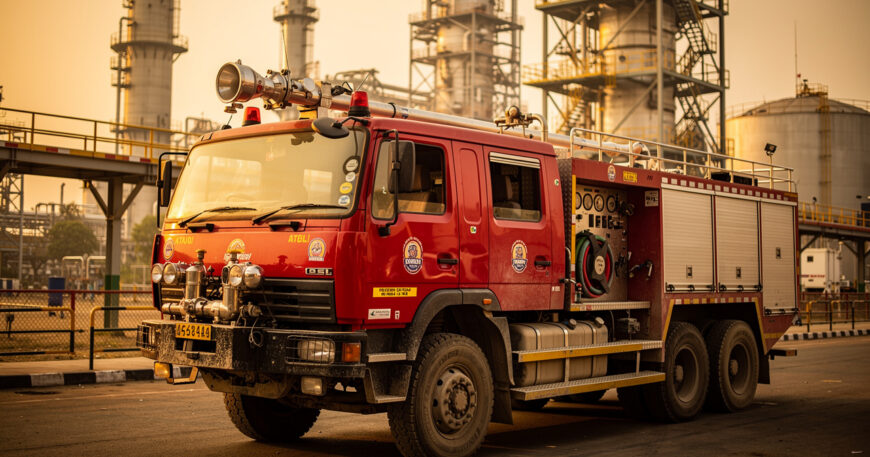
Selecting the right fire tender for an industrial site is not just a budget decision; it is a life-safety decision. A Fire Tender Selection Guide For Industrial Sites In India 2026 should turn a confusing purchase into a clear safety plan. When the wrong vehicle arrives at a refinery or plant fire, seconds vanish while crews struggle with unsuitable agents, and that delay can cost equipment, production, and lives.
At the same time, regulations for hazardous industries keep tightening and industrial zones keep expanding across India. Fire safety officers now face heavier expectations from regulators, insurers, and corporate boards. According to NFPA, industrial and manufacturing properties see tens of thousands of fires worldwide every year, with some of the highest losses per incident.
In this guide, we explain how different fire tender types serve Indian industrial sites, which technical specifications matter most, and how Indian standards such as OISD, BIS, PESO, and MHA rules shape every purchase. We also connect tender choice to real hazard profiles across refineries, chemical plants, steel mills, and construction projects. Throughout, we draw on our experience at Seaara Universal Private Limited helping plants align mobile firefighting fleets with fixed systems, trained crews, and long-term maintenance.
As many industrial fire officers put it, “The worst time to discover a gap in your firefighting fleet is during a real emergency.”
If you want your next tender order to stand up to both inspection day and emergency day, stay with us through each section.
Key Takeaways
These points show how a Fire Tender Selection Guide For Industrial Sites In India 2026 translates into real choices on the ground. You can review them first, then read the detailed sections that follow. Each takeaway links directly to decisions that safety managers and project heads face before signing a purchase order.
- Fire tender type must match the dominant fire class on site. Water, foam, DCP, crash, and multipurpose units each serve different hazards. If a site relies only on water trucks in a solvent storage area, suppression efforts can fail very quickly. Matching vehicles to real risks keeps crews from guessing under pressure.
- OISD, BIS, and PESO compliance are non‑negotiable baselines. These bodies define performance, capacity, and deployment rules for high‑risk industries. Non‑compliant vehicles can be rejected during audits or insurance surveys even if they work mechanically. Treat compliance certificates as entry tickets before you even compare prices.
- Site risk assessment must precede any procurement decision. A formal hazard study maps fuels, layouts, access routes, and water supply. Without this step, specification work is guided by catalogues instead of real fire scenarios. We regularly see costlier retrofits when plants skip this early assessment.
- Life cycle cost matters more than purchase price alone. Fire tenders run for many years, and fuel, spares, downtime, and AMC bills soon overtake the initial cheque. According to NFPA, fire trucks often serve for 15 to 20 years in front‑line roles, so weak designs punish owners for a long time. Looking only at the lowest quote can quietly raise total risk and expense.
- Integration with fixed systems decides overall response effectiveness. Tenders should work as part of a wider protection plan that includes hydrants, sprinklers, foam systems, and alarms. Poorly matched hose couplings or hydrant spacing can slow every response. When mobile and fixed systems are planned together, operators get faster, simpler attack lines.
Types Of Fire Tenders And Their Industrial Applications

Types of fire tenders for Indian industrial sites fall into five main groups that match different hazards. Choosing correctly means linking each vehicle to the fire classes and scenarios that appear in your facility. Any Fire Tender Selection Guide For Industrial Sites In India 2026 has to start from these categories.
- Water tenders are the workhorses of most industrial fleets. They carry large water tanks, usually between 2,000 and 10,000 litres, along with pumps and hose lines suited to Class A fires. Manufacturing plants, warehouses, and commercial complexes rely on these units for building fires, packaging fires, and general exposures. Their limits appear where flammable liquids or energised equipment dominate.
- Foam tenders focus on Class B fires involving hydrocarbons and many solvents. They store foam concentrate and water, then feed monitors and nozzles through proportioning systems that keep the mix within tight limits. Petroleum refineries, fuel depots, tank farms, and many chemical plants treat foam tenders as main attack units. OISD guidance for these sectors places strong attention on foam capacity and application rates.
- Dry Chemical Powder (DCP) tenders handle live electrical risks and special chemical fires. They carry large DCP agent tanks with fast discharge systems for transformers, gas leaks, and process units where water can cause violent reactions. Electrical substations, LPG bottling plants, and gas compressor stations across India use DCP units as a rapid knockdown line while water or foam units protect exposures.
- Crash Fire Tenders serve airfields and helipads that sit inside or beside industrial complexes. These vehicles combine high speed, large foam and water capacity, and often DCP lines on turrets. Guidance from the International Civil Aviation Organization expects airport rescue vehicles to reach any point on an active runway within about three minutes, which shapes their design. Industrial plants with private strips or defence links often share these fleets.
- Multipurpose tenders combine water, foam, and sometimes DCP into a single chassis. These units suit mid‑sized industrial estates and Tier 2 or Tier 3 city clusters where full fleets are hard to justify. When specified correctly, one multipurpose truck can cover mixed hazards in textile units, light engineering clusters, or growing logistics parks.
When you map your hazards to these tender types, you create a simple matrix of fire classes vs. vehicles, which forms the backbone of any industrial fire fleet strategy.
What Technical Specifications Should You Evaluate Before Buying A Fire Tender?

Technical specifications for an industrial fire tender decide how it will perform during the toughest fifteen minutes of its life. Safety managers should measure every spec against the fires expected on site, not against a generic brochure. When we build our internal Fire Tender Selection Guide For Industrial Sites In India 2026, we focus on a small group of high‑impact parameters.
Key items to examine include:
- Pump capacity and pressure rating
- Water and foam tank size
- Chassis and driveline
- Delivery equipment and crew accommodation
Pump capacity and pressure rating sit at the top of that list. Flow rate in litres per minute and discharge pressure in bar decide whether streams reach upper floors, tank tops, or remote pipe racks with enough force. For many industrial plants, pumps of 2,000 LPM or more at 10 bar or higher are standard. BIS standard IS 950 and NFPA 1901 both describe how fire pumps should perform and be tested.
Tank capacity for water and foam must align with the worst credible event and the time until extra supply arrives. Refineries and large depots often specify 6,000‑litre or larger water tanks and foam concentrate sized for sustained application on the largest tank or dike fire. Undersized tanks mean crews run dry while the fire still grows. Sites with weak hydrant flow or no static water storage must compensate with even larger on‑board supplies.
Chassis and driveline choices should reflect terrain, gradients, and access routes inside the plant. Narrow roads or tight bends may need shorter wheelbases. Unpaved routes toward tank farms or high ground may require all‑wheel drive. For hazardous zones, electrical systems and exhaust routing must reduce ignition risk, and ATEX or equivalent safety ratings become very important.
Delivery equipment and crew accommodation also deserve close study. Hose diameter, hose bed capacity, and roof monitor reach decide how far crews can attack while staying at safe distances. Monitors capable of about 50 metres throw help in many high‑hazard layouts. Cab design should allow space for SCBA sets, chemical suits, and basic rescue tools so that crews arrive ready to act, not wasting time hunting for essential gear.
Tip from the Seaara Universal Private Limited field team: “During technical evaluation, ask vendors to demonstrate real pump output and monitor reach at site conditions, not just on paper.”
Regulatory Compliance Framework For Fire Tender Procurement In India

Regulatory rules for industrial fire tenders in India create a firm baseline that every vehicle must meet before a site looks at price. These rules come from several agencies, and together they describe performance, documentation, and deployment expectations. Buying outside this framework invites inspection problems and insurance disputes.
The Bureau of Indian Standards (BIS) publishes IS 950 for firefighting vehicles and other IS codes for pumps, hoses, foam, and fittings. When we support clients, we always ask vendors to show BIS compliance certificates and recent test reports for these parts. The Bureau of Indian Standards explains how such certification links to product testing in accredited labs, which helps buyers filter out weak equipment.
For petroleum and chemical facilities, the Oil Industry Safety Directorate (OISD) sits at the centre of compliance. Standards such as OISD 117 and OISD 145 set minimum numbers, types, and capacities of tenders, along with foam design rules expressed in litres per minute per square metre of risk area. The Oil Industry Safety Directorate also stresses that fire protection plans must arise from formal risk assessments, not from simple thumb rules.
PESO rules apply where LPG, petroleum, or explosives are stored or processed under licence. These rules connect storage approvals to fire protection capability, which includes mobile tenders in many settings. The Factories Act and related State Factory Rules require adequate firefighting arrangements for registered plants, while State Fire Service Acts and Ministry of Home Affairs advisories guide local approvals for high‑hazard occupancies.
Insurance‑linked bodies such as the Tariff Advisory Committee and large underwriters often add their own expectations for minimum fire truck capacity and agent stocks. When we help prepare tender documents, we always suggest building all these requirements into the technical bid, so compliance is proven before any financial quote is opened.
How To Match Fire Tender Selection To Your Site’s Hazard Profile

Matching fire tender selection to a site hazard profile turns regulations and data sheets into a focused buying decision. The right match starts from fuels, layouts, and operating patterns rather than from dealer catalogues. Our own Fire Tender Selection Guide For Industrial Sites In India 2026 uses hazard profiling as its main anchor.
- Petroleum refineries and petrochemical complexes live with large hydrocarbon inventories and high thermal radiation risk. These sites usually need multiple large foam tenders with AFFF or AR‑AFFF concentrates, supported by heavy water tenders for cooling structures and neighbouring tanks. DCP units help with gas leaks and pressurised fires. OISD foam design rules and tank farm layouts drive the exact capacities and numbers.
- Chemical plants need closer study of Material Safety Data Sheets before any tender choice. Some chemicals react badly with water, while others demand specific foam types for safe control. DCP tenders and even specialised agents can be necessary near certain reactors or storage areas. We often support chemical clients by mapping each process area to suited agents and then back to the right mix of tenders.
- Steel plants, smelters, and heavy engineering shops bring in molten metal, slag pits, and very hot surfaces. Water applied in the wrong place can trigger explosive reactions, so DCP or special dry media are often positioned near hot metal zones. Larger water tenders still protect buildings, cable tunnels, and warehouses on the same campus.
- Construction and infrastructure sites, by contrast, need compact, highly mobile multipurpose tenders that can move with the workfront and often share duty with nearby municipal brigades. Ground conditions, temporary fuel storage, and access constraints should all shape specifications.
According to National Disaster Management Authority, Major Accident Hazard units must prepare and maintain on‑site emergency plans that include identified firefighting resources. At Seaara Universal Private Limited, we support that requirement by carrying out detailed fire audits and risk assessments, then proposing exact tender counts, capacities, and agent types before any specification is written.
Practical recommendation: keep a one‑page hazard‑to‑tender map in your control room so that new staff and mutual‑aid teams can see which vehicle is meant for which risk area at a glance.
Why Seaara Universal Private Limited Is Your End-To-End Fire Tender Partner

Seaara Universal Private Limited serves industrial clients as a single partner from risk study through to tender commissioning and maintenance. We combine field experience with engineering depth so that every truck choice fits both standards and on‑ground reality. For buyers who want more than catalogue advice, this joined‑up view makes a major difference.
We are an ISO 9001 certified fire safety provider with strong focus on heavy industry. According to the International Organization for Standardization, more than one million organisations worldwide use ISO 9001 to structure consistent quality management, and we apply that discipline to fire vehicle projects as well. Our fire tenders and related equipment follow ISI, CE, OISD, and UL benchmarks, which keeps regulatory and insurance reviews simpler for clients.
Beyond vehicles, we design and commission hydrant networks, water spray systems, and sprinkler layouts that work smoothly with tender pump and hose capacities. As an authorised partner of NOTIFIER USA, we also integrate detection and alarm systems so that crews get clear, early information about fire location and type. This combination of mobile response, fixed suppression, and smart detection keeps plant fire protection aligned under one plan rather than split across many vendors.
Seaara Universal Private Limited is also a pioneer of Aerosol Suppression Systems using 4G technology in India, along with advanced micro mist systems for sensitive areas. These technologies do not replace fire tenders for many risks, but they can reduce demand on trucks and give earlier knockdown in confined spaces. We also provide certified firefighting manpower, operator training, and full Annual Maintenance Contracts, so that a truck we supply remains inspection‑ready and reliable throughout its service life.
In a market that includes Seaara Universal Private Limited, alongside brands such as Minimax, Ceasefire, Safex, Firepro, and Kanex, our edge lies in this wide but connected offering. Industrial clients do not have to balance separate agencies for vehicles, hydrants, alarms, and manpower. They work with one team that sees the whole risk picture from hazard study to long‑term upkeep.
The Bottom Line Get Your Fire Tender Selection Right From The Start
Fire tender selection for Indian industrial sites is a safety‑centred, regulation‑driven task rather than a simple equipment purchase. When tenders match hazards, standards, and fixed systems, they give crews the best chance to control fires during those first hard minutes.
A structured approach such as this Fire Tender Selection Guide For Industrial Sites In India 2026 helps safety managers compare choices against real plant risks instead of headline features. At Seaara Universal Private Limited, we support that approach through fire audits, specification help, compliant vehicle supply, and life cycle maintenance. If you want your next tender order to protect people, assets, and production from day one, we are ready to work with your team from assessment to commissioning.
Frequently Asked Questions
Question: What is the minimum fire tender requirement for a petroleum refinery under OISD standards?
The minimum fire tender requirement for a refinery follows OISD 117 and OISD 145 rules. These standards set expectations for water and foam tender types, foam concentrate stock, response times, and deployment patterns. Every petroleum sector site must treat OISD compliance as a starting point and then adjust upward based on its own risk profile.
Question: How often should industrial fire tenders undergo maintenance and inspection?
Industrial fire tenders should receive daily checks, monthly functional tests, and yearly full inspections. Daily checks cover fluids, tyre condition, and basic pump starts. Monthly testing confirms pump output, monitor movement, and communication systems. Annual inspection reviews overall vehicle safety, measured pump performance, and foam system accuracy, and is often supported through structured AMC programs.
Question: Can a multipurpose fire tender replace specialized foam and DCP tenders at a chemical plant?
A multipurpose tender can support mixed risks, but it rarely replaces dedicated foam and DCP units in high‑hazard chemical plants. OISD and PESO expectations for agent volume and application rate are often too high for a single vehicle. A formal hazard study and review of MSDS documents should guide any move to rely mainly on combination trucks.
Question: What documentation is required in a fire tender technical bid submission in India?
A fire tender technical bid usually includes detailed vehicle specifications and compliance declarations to BIS, OISD, and PESO where relevant. Buyers also ask for past supply records, performance certificates from similar plants, warranty clauses, spare parts support letters, and information on authorised service centres. Clear documentation at this stage prevents disputes once the vehicle arrives on site.
Question: How does Seaara Universal Private Limited support fire tender procurement beyond equipment supply?
Seaara Universal Private Limited supports clients across the full fire protection chain, not just with trucks. We perform site fire audits, help draft specifications, and supply certified firefighting manpower. Our team designs hydrant and suppression systems, integrates NOTIFIER USA alarm technology, and runs Annual Maintenance Contracts so that fire tenders and linked systems stay ready throughout their service life.