


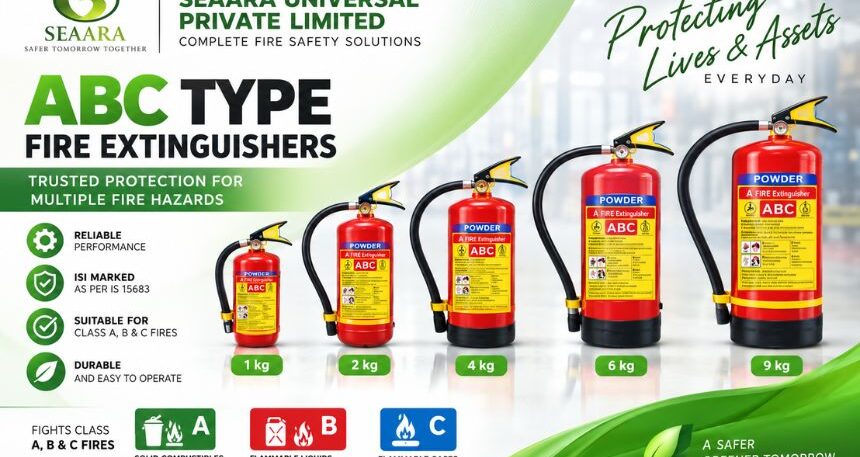
An ABC type fire extinguisher uses dry chemical powder to interrupt the combustion process and put out fires. It can be rated for ordinary combustibles, flammable liquids, flammable gases, and selected electrical hazards, which makes it a common first-line option for many Indian homes, shops, offices, and industrial areas when correctly selected and installed.
A loose cable in a cramped DG room arcs, catches the oily dust on a nearby panel, and flames start climbing towards stacked cardboard cartons. In that moment, an ABC type fire extinguisher can knock the fire down fast, it throws a cloud of dry chemical powder across the base of the fire, interrupts the combustion reaction, and can be used against ordinary combustibles, flammable liquids, flammable gases, and applicable electrical hazards when the extinguisher is appropriately rated and marked.
That versatility is exactly why the ABC type fire extinguisher is widely used across Indian homes, offices, shops, warehouses, and industrial sites. But most people who own one don’t actually know how it works, what the ratings on the label mean, or where it should never be used. This guide covers all of that, how an ABC extinguisher works, how it compares with DCP and CO₂ units, how sizing and ratings work, how to use the PASS method, and what keeps it reliable under applicable Indian standards.
Key Takeaways
An ABC type fire extinguisher commonly uses monoammonium phosphate (MAP) dry powder to handle ordinary combustible materials and flammable-liquid and flammable-gas hazards covered by its certified rating. It can also be suitable for use around energised electrical equipment when the extinguisher meets the applicable electrical-safety requirements.
It is not a universal solution, metal fires and cooking-oil fires need specialised agents and equipment appropriate to those hazards.
ABC is a type of DCP (dry chemical powder) extinguisher. Not every DCP extinguisher covers all the same fire hazards, always check the fire classification and rating on the label.
Ratings like “2A 34B” describe tested fire-fighting performance, not simply cylinder weight. Two extinguishers with the same nominal capacity can have different ratings.
The PASS method, Pull, Aim, Squeeze, Sweep, provides a simple sequence for operating a portable extinguisher; aiming at the base of the fire, rather than the top of the flames, is essential.
Regular inspection, scheduled maintenance, and prompt recharging after use help determine whether a unit will work when needed.
What Is an ABC Type Fire Extinguisher?
An ABC type fire extinguisher is a portable or trolley-mounted dry chemical unit rated for specified fire classes using a suitable powder agent. In Indian homes, offices, factories, and infrastructure projects, it is widely used as a first-line extinguisher because one cylinder can cover several common fire hazards without requiring a separate extinguisher for every type of fuel.
At its core, the extinguisher contains dry chemical powder, a cylinder, an operating valve, and a pressurisation system. Many ABC powder extinguishers use monoammonium phosphate (MAP)-based powder, although the exact extinguishing medium should always be verified against the manufacturer’s product specification and certification.
Portable fire extinguishers in India are covered by standards including IS 15683:2018, which specifies performance and construction requirements for portable fire extinguishers. Buyers should check the applicable certification, markings, fire rating and product documentation rather than relying only on generic descriptions.
For current capacities and product specifications, see Seaara Universal’s ABC type fire extinguishers.
What Does ABC Stand For? The Three Fire Classes It Covers
The letters refer to the classes of fire for which the extinguisher is tested and rated, not a brand name or a chemical formula.
Class A – ordinary solid combustibles wood, paper, cardboard, rubber, plastics and similar solid materials.
Class B – flammable liquids petrol, diesel, paints, solvents, oils and other applicable flammable-liquid hazards.
Class C – flammable gases fires involving flammable gases under pressure, including liquefied gases, where an appropriate extinguishing agent is required to suppress the burning gas.
Electrical equipment requires separate consideration. An extinguisher suitable for use on energised electrical equipment should meet the applicable electrical-safety requirements and carry the appropriate marking or information. Electricity itself is not the fuel being extinguished; the fire involves the material that is burning around the electrical equipment.
A single shop floor storing cardboard cartons, diesel drums, and a control panel in the same bay is a good example of why a multi-purpose ABC extinguisher can be useful, one appropriately selected extinguisher can address several common hazards.
Where an ABC Extinguisher Should Not Be Used
ABC powder is not a universal agent. It should not be assumed suitable for:
Class D metal fires burning magnesium, aluminium powder, sodium and other combustible metals require specialised extinguishing agents and techniques appropriate to the particular metal.
Cooking-oil and deep-fat fryer fires commercial kitchens and fryer lines can require wet-chemical extinguishers or fixed systems specifically designed for cooking-oil hazards.
Sensitive electronics in server rooms, clean rooms, control environments and instrument laboratories, powder residue can create contamination and equipment-recovery problems. CO₂ or clean-agent protection may be more appropriate for specific sensitive equipment, depending on the risk assessment.
The correct extinguisher should always be selected according to the actual fire hazard, the product’s certified rating and applicable fire-safety requirements.
What’s Inside an ABC Dry Chemical Fire Extinguisher
The cylinder is typically manufactured from a suitable metal or other approved construction with protective finishes appropriate to the product design. Inside sits the dry chemical powder along with the pressurisation arrangement, which on activation drives the powder through the discharge assembly and towards the fire.
ABC powders commonly use monoammonium phosphate as the principal extinguishing ingredient. The powder formulation is designed to provide the required fire-fighting performance while remaining suitable for storage and discharge under the conditions specified by the manufacturer.
Two operating arrangements are commonly encountered. In stored-pressure units, the pressurising gas is stored within the extinguisher and the pressure condition can normally be checked using the fitted indicator where provided. In cartridge-operated units, a separate gas cartridge is activated to pressurise the extinguisher during operation.
The precise construction, extinguishing medium and operating arrangement vary by product, so the manufacturer’s technical documentation should be used when specifying or servicing an extinguisher.
How Does an ABC Type Fire Extinguisher Actually Work?
When the handle is squeezed, pressurised gas propels a cloud of powder towards the fire. The powder interrupts important chemical reactions in the flame and, on suitable solid fuels, can form a coating over the burning surface that helps suppress continued combustion.
On Class B fires, the powder cloud helps interrupt the combustion process and separate the flame from the fuel surface. The operator should aim at the base or near edge of the fire and sweep the discharge across the burning area without unnecessarily disturbing or spreading the burning liquid.
For energised electrical equipment, only an extinguisher suitable for electrical applications should be used. The electrical supply should be isolated whenever this can be done safely.
What ABC powder does not do particularly well is cool fuel deeply in the way water can. Deep-seated fires inside stacked cartons or other porous materials can therefore appear to be extinguished and then re-ignite, which is why follow-up cooling, monitoring or overhaul may be required after the immediate fire has been controlled.
ABC vs DCP – Are They the Same?
DCP stands for dry chemical powder and is the broader category covering powder-based extinguishers, including ABC, BC and specialised Class D types.
An ABC unit is therefore a DCP extinguisher, but a DCP extinguisher is not necessarily an ABC extinguisher. It might instead be designed for BC hazards or a specialised metal-fire application.
For Indian procurement, this distinction matters at the tender stage. It is safer to specify the required powder type, applicable Indian Standard, fire rating and certification rather than simply requesting a “DCP” extinguisher.
Buyers should require the extinguisher body and documentation to clearly identify the applicable fire classification and rating rather than relying only on a kilogram figure.
ABC vs CO₂ – Which Should You Choose?
This is not about which extinguisher is better in the abstract, it is about which agent suits the specific room and hazard.
| ABC Dry Powder | CO₂ | |
|---|---|---|
| Ordinary combustibles | Suitable where appropriately rated | Limited on deep-seated fires |
| Flammable liquids | Suitable where appropriately rated | Suitable for applicable liquid fires |
| Electrical equipment | Can be suitable when appropriately rated and marked | Commonly used for applicable electrical hazards |
| Residue after use | Powder residue remains | No powder residue |
| Sensitive electronics | Powder may create contamination and cleaning problems | Often preferred where a residue-free agent is required |
| Best suited for | Mixed-risk areas such as offices, warehouses and general work areas | Selected electrical/electronic and liquid-fire hazards |
Many Indian facilities use both, ABC extinguishers in general areas and along suitable access routes, with CO₂ or clean-agent protection in selected electrical and electronic environments.
The final choice should be based on the actual hazard, fire rating, equipment sensitivity and applicable fire-safety requirements.
Understanding Ratings What “2A 34B” Means
The fire rating on the label, something like 2A 34B, represents tested fire-fighting performance against standardised test fires.
The A rating relates to the extinguisher’s performance against the applicable Class A test fire, while the B rating relates to the applicable Class B test fire. A higher number generally represents greater tested performance against the corresponding standardised test fire.
The rating should not be inferred solely from the extinguisher’s kilogram capacity. The manufacturer declares the fire rating for the particular extinguisher configuration, and the relevant capacity and rating should be verified from the product nameplate, certification and technical documentation.
For example, if a product is marked 2A 34B, that specific rating is part of the tested and declared performance of that extinguisher. It should not be assumed that every extinguisher of the same weight will carry the same rating.
Common ABC Fire Extinguisher Sizes
ABC powder extinguishers are available in several capacities. Depending on the product range and certification, common portable capacities include:
1 kg
2 kg
4 kg
6 kg
9 kg
Larger wheeled or trolley-mounted powder extinguishers are also available for higher-risk industrial applications.
The correct capacity should be selected according to the fire hazard, required fire rating, travel distance, installation requirements, user capability and applicable fire-safety provisions.
A larger extinguisher is not automatically the right extinguisher. The objective is to provide adequate tested fire-fighting capability while ensuring that the equipment can be safely accessed and operated.
For current capacities and specifications, see Seaara Universal’s ABC type fire extinguisher range.
How to Use One The PASS Method
Before touching the cylinder, raise the alarm, call for help, and make sure you have a clear escape route behind you. If the fire is still small and the right extinguisher is on hand, PASS provides a simple sequence to follow under pressure.
P – Pull the safety pin or remove the approved safety device.
A – Aim the nozzle at the base of the fire, not the top of the flames. Stand upwind where practical.
S – Squeeze the operating handle to discharge the extinguishing agent.
S – Sweep the discharge from side to side across the base of the fire.
The exact discharge time and effective range depend on the extinguisher’s design and certified specifications, so users should not rely on generic discharge-time estimates.
Withdraw immediately if the fire grows, smoke becomes unsafe, or your escape path is threatened.
When Not to Fight the Fire Yourself
Do not attempt to fight a fire with a portable extinguisher when flames already involve a whole room, when smoke is thick enough to obscure the exit, when you are unsure of the fire hazard, or when you do not have a clear path to retreat.
Portable extinguishers are intended as a first line of defence against fires of limited size. In situations where the fire is growing beyond safe portable-extinguisher use, evacuating and raising the alarm should take priority.
Where ABC Extinguishers Are Used
ABC extinguishers are widely used across Indian occupancies because of their flexibility, residential buildings, offices and co-working spaces, shops and malls, schools and hospitals, and small industries, warehouses, DG rooms and parking areas.
The number, capacity, rating and placement of extinguishers should be determined according to the building’s hazards and applicable fire-safety requirements.
For current capacities and specifications, see Seaara Universal’s ABC type fire extinguisher range.
Maintenance, Inspection, and Shelf Life
A cylinder that looks fine from a distance can still have low pressure, physical damage, corrosion or other defects if nobody checks it regularly. Proper inspection and maintenance are essential to keep an extinguisher ready for use.
Routine inspections Under IS 2190:2024, extinguishers should be checked at approximately 90-day intervals, or more frequently where circumstances require. Checks include location, accessibility, operating instructions, seals, physical condition, fullness and pressure indication where provided.
Annual maintenance Portable extinguishers should undergo maintenance by competent persons at the intervals specified by the applicable standard and manufacturer. IS 2190:2024 specifies maintenance once a year, with maintenance intervals not less than six months apart.
Hydrostatic pressure testing Hydrostatic testing should be carried out at the intervals specified by the applicable standard and product requirements. Any extinguisher that fails the required test or has unacceptable damage should be removed from service.
After discharge A rechargeable extinguisher that has been discharged should be removed from service and recharged with the correct extinguishing medium and components before being returned to service.
Maintenance and recharging should follow the manufacturer’s service instructions and use the appropriate replacement parts and recharge materials.
With proper inspection, maintenance and storage, extinguishers can remain serviceable for many years, although corrosion, physical damage, environmental exposure and other conditions can shorten their useful service life.
For facilities managing multiple units, Annual Maintenance Contract services can help organise inspection, refilling, testing and documentation.
Common Mistakes to Avoid
Choosing by kilogram weight alone and ignoring the fire rating printed on the label.
Installing powder extinguishers in sensitive electronic environments without considering residue and equipment-recovery requirements.
Blocking extinguishers behind storage racks or placing them where they cannot be reached quickly.
Assuming the PASS method is obvious and skipping practical training.
Ignoring damaged, discharged, poorly maintained or non-compliant extinguishers.
Treating a single ABC extinguisher as a complete fire-safety plan instead of one layer alongside alarms, detection, hydrants, sprinklers and trained emergency response.
FAQs About ABC Type Fire Extinguishers
What is an ABC fire extinguisher?
An ABC fire extinguisher is a dry chemical powder extinguisher designed and tested for applicable Class A, B and C fire hazards. Under IS 15683, these classes refer to ordinary solid combustibles, flammable liquids and flammable gases respectively. An appropriately tested and marked extinguisher may also be suitable for use on energised electrical equipment.
Are ABC and DCP fire extinguishers the same?
Related but not identical. DCP means dry chemical powder, while ABC identifies a powder extinguisher with the applicable ABC fire classification and rating. Other DCP extinguishers may be designed for BC or specialised Class D applications. Always check the printed classification and rating rather than relying on the word “DCP” alone.
Is an ABC or CO₂ fire extinguisher better?
Neither is universally better. ABC powder is useful for many mixed fire hazards but leaves powder residue. CO₂ leaves no powder residue and can be appropriate for selected electrical and electronic hazards. Many facilities use both, matched to the specific room and risk.
What is a “5 ABC” fire extinguisher?
“5 ABC” is informal marketing or trade shorthand rather than a substitute for the extinguisher’s certified rating. Check the actual fire rating and nominal capacity on the nameplate and product documentation.
How often should an ABC fire extinguisher be serviced?
Routine inspections should be carried out at approximately 90-day intervals under IS 2190:2024, or more frequently where circumstances require. Professional maintenance should be performed annually by competent persons, with maintenance intervals not less than six months apart. Hydrostatic testing should be carried out at the intervals specified by the applicable requirements. A rechargeable extinguisher should also be recharged after discharge before being returned to service.
Conclusion
An ABC type fire extinguisher earns its place as a widely used first-line extinguisher across Indian homes and workplaces because it can address several common fire hazards in a single unit, but that versatility only holds up if it is correctly rated, properly selected, correctly installed and maintained.
Understanding what is inside the cylinder, how the rating on the label relates to tested fire performance, and when to use a different extinguisher, such as CO₂, wet chemical or a specialised Class D agent, turns a red cylinder on the wall into equipment you can rely on.
If this is prompting a review of your current extinguisher mix, you can explore specifications and capacities in Seaara Universal’s ABC type fire extinguisher range, or enquire about Annual Maintenance Contract services to help keep inspections, refills and testing on schedule.